
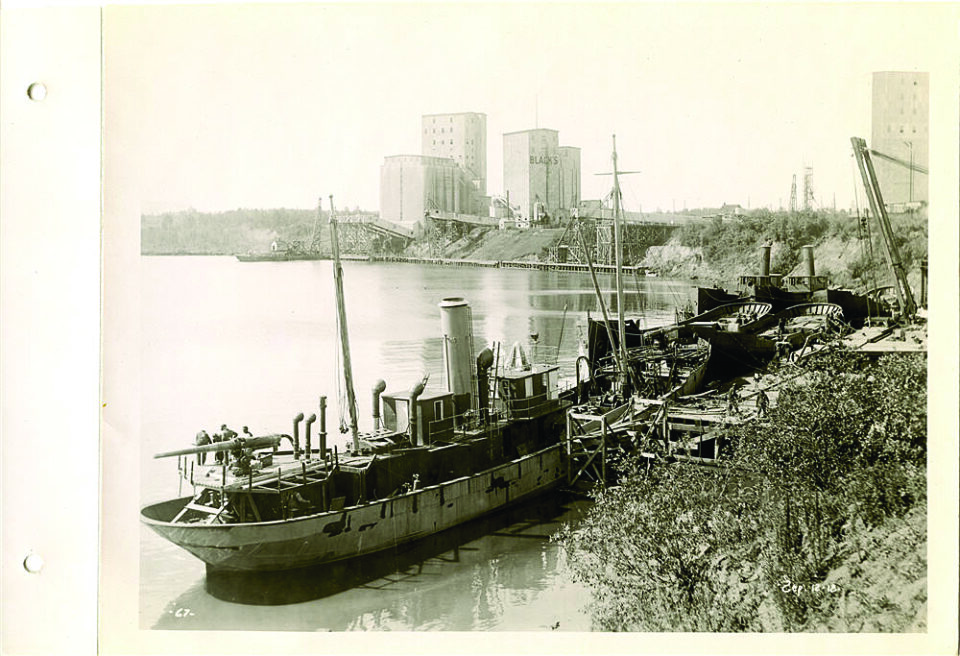
It was Nov. 23, 1918—just 12 days after the end of the First World War on Nov. 11. Yet three French Navy warships still had to be delivered across Lake Superior to France. Built at Canadian Car and Foundry Co. (“Can-Car”) in Fort William (now part of the city of Thunder Bay), the three ships—Sebastopol, Inkerman, and Cerisoles—began their journey on Nov. 23.
Within days, two of the three had mysteriously disappeared.
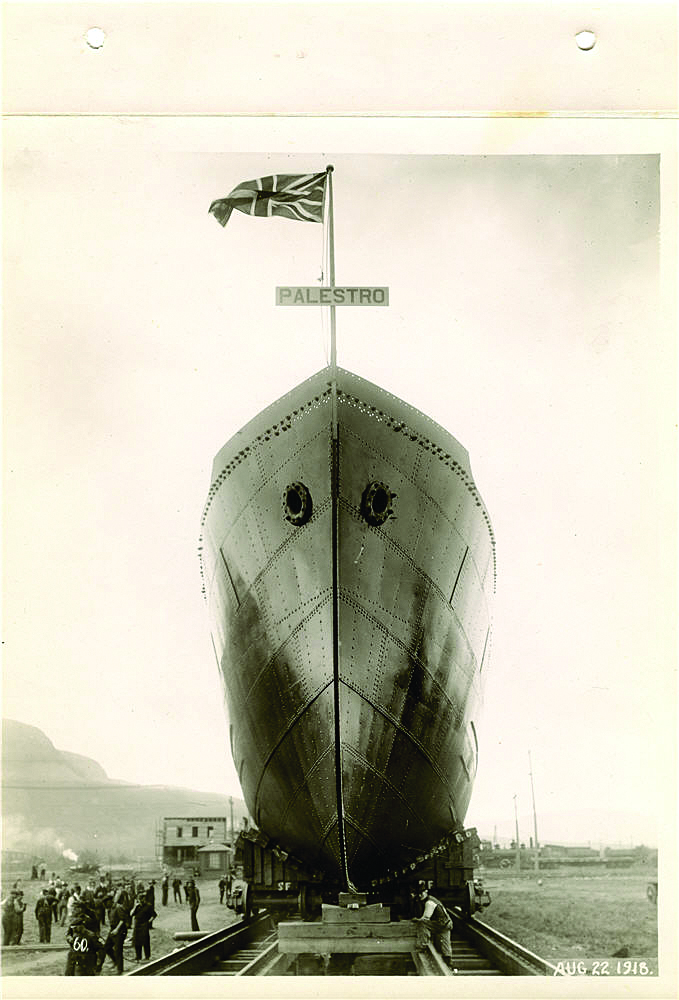
The three were the last of 12 Navarin-class minesweepers built by Can-Car for the French Government. The U.S. $2.6 million contract (equivalent to $53.6 million today) was the result of a cooperative effort with Wisconsin’s Manitowoc Shipbuilding Co. and negotiations with the French Military Navy Department. It came with a tight deadline: the first ship had to be launched for sea trials on Lake Superior on July 29, 1918, and the last, three months later, on Oct. 14. Over 1,000 Can-Car employees worked to meet the time frame of getting all the ships on their way in fall. The ships were all named after French battle victories: Navarin, Mantoue, St. Georges, Leoben, Palestro, Lutzen, Seneff, Malakoff, Bautzen, Sebastopol, Inkerman, and Cerisoles.
The trawler minesweepers were 135 feet (41.3 m) long with a beam of 22.5 feet (6.8 m). Built for heavy seas and rugged duty, they had steel-framed wooden hulls, triple-expansion American-built 600-hp engines, wireless communication, four watertight compartments, two 100 mm (4-inch) deck-mounted guns, and could reach a top speed of 12.5 knots (14.4 mph).
After leaving Thunder Bay, the convoy’s overall commander, Captain Marcel Leclerc, positioned his Sebastopol to lead as the pilot ship, sailing about a mile ahead of the other two, Inkerman and Cerisoles. Sometime between midnight and 1 a.m. on Nov. 24, Leclerc noted that the Inkerman and Cerisoles were about 10 miles (16.1 km) north of Manitou Light. It was the last known sighting of the two ships.
At the time, although the weather was clear, there was heavy seas and a southwest wind. By afternoon, the weather had deteriorated to blizzard conditions with thick snow. According to Leclerc, the storm became so severe that his ship headed toward Keweenaw Point for protection at Bete Gris Bay. White water was on the deck, several of her seams broke, and she ran her pumps to handle the water she was taking on. Sebastopol made it to the Sault Ste Marie locks on Nov. 26 and continued on down the lakes, expecting the Inkerman and Cerisoles to soon follow. They never did.
The two minesweepers disappeared in what remains the largest unexplained loss of life on the Great Lakes: a total of 77 French Navy seamen (39 on Inkerman, 38 on Cerisoles), plus two licensed Canadian pilots, Captain J.W. Murphy and Captain R. Wilson. Many of the French crew members were war veterans, several having received the French War Cross for bravery.
Almost immediately, speculation and conspiracy theories began about their fate. Were they sabotaged? Why did the French Navy seem unconcerned about their loss? Did they go off course and hit the Superior Shoals? Were they scuttled for insurance money since the war was over? Was their loss due to “very bad stability problems,” as suggested in French Warships in World War 1? Did they sail under secret orders to undisclosed American ports? And questions swirled about the report that, before leaving, sealed orders were given to each captain by French authorities, with instructions not to open them until cleared of Thunder Bay Harbour.
Years later, two skeletons in naval uniforms with French ID were found on West Sand Bay of Michipicoten Island. They were buried in unmarked graves, and ID tags were sent to authorities. But there was no confirmation of whether they were from the missing warships.
While the Inkerman and Cerisoles have gained legendary status on the lake for their mysterious disappearance, some of the other 10 warships also have fascinating tales. For example, the minesweeper Bautzen became a luxury steam yacht renamed Rowena. Later, she was renamed Peary and was part of the 1925 MacMillan Arctic Expedition. Four years later, in 1929, she served as the exploration ship on the Bramley Expedition to the tropical Pacific, searching for the mythical “Dream Island.” In 1941, she was back in Lake Superior as Peary, conducting soundings around the Superior Shoals for the U.S. Lake Survey. Twenty years later, on Aug. 22, 1961, after leaving Newfoundland with a cargo of 250 tons of bulk salted fish, she sprang a leak and sank within three hours.
As for the Sebastopol, she ended up a rum runner sometime after being sold to the government of Newfoundland (then still a British colony) in 1920. According to The New York Times on Aug. 12, 1927, she was seized by U.S. Coast Guard Cutter 145 as a “pirate rum ship” called Westmoreland at 3 a.m. in the Narrows (the strait between Upper New York Bay and Lower New York Bay), with 5,000 cases of liquor valued at $300,000 (equivalent to $5.6 million today). It was obvious her name, Sebastopol, had recently been covered with fresh paint. The NYT article confirmed her Lloyd’s Registry listing as the Sebastopol, built in 1918 by Canadian Car and Foundry Company at Fort William. In 1933, she was wrecked off Newfoundland’s Cape St. Francis.
And the Inkerman and Cerisoles? Still missing, their location unknown 107 years later.