

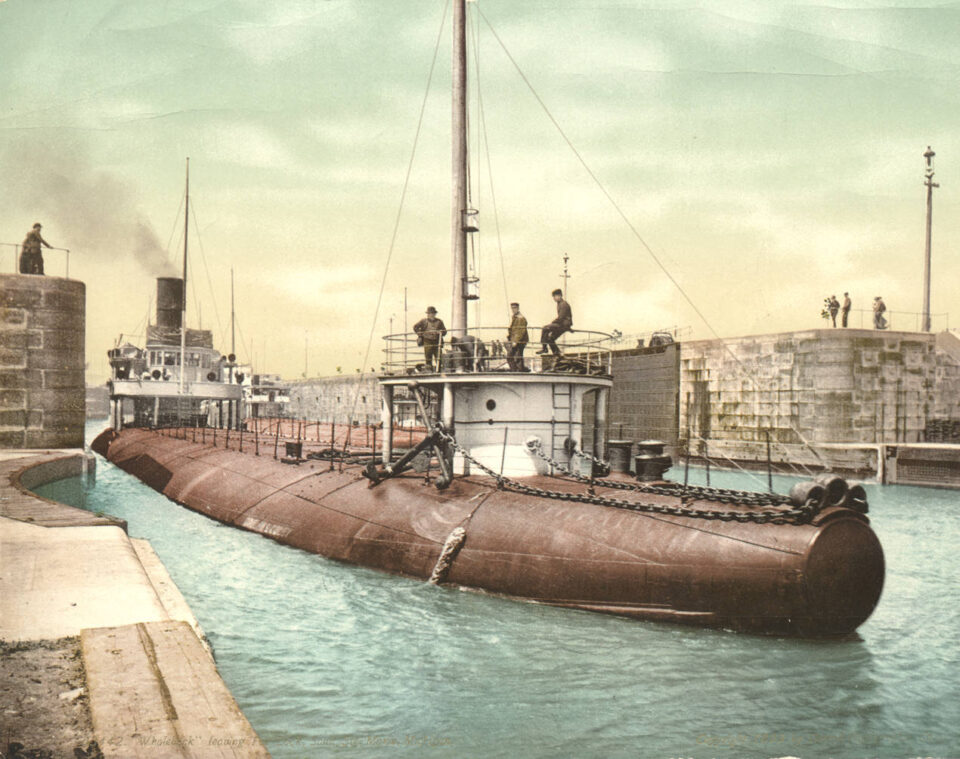
So, first of all, what’s a whaleback? They were an unusually designed type of cargo steamship built to haul bulk freight, grain, gravel, and iron ore on the Great Lakes. Built with a long, narrow cylindrical hull shaped like a cigar, when a whaleback was fully loaded with cargo, the rounded hull seen above the waterline looked like the smooth back of a whale. The quirky term “whaleback” for the ship developed in response to its whale-like appearance.
“The whaleback’s profile was considered ‘grotesque’ by some lakemen, but its designer declared that such a ship ‘can’t be drowned. They’ll ride out any storm because the seas will simply wash over them,’” wrote Ric Mixter in his article, “McDougall’s Dream” in Michigan History (May-June 2013).
It was Duluth’s Scottish-born Captain Alexander McDougall (1845-1923) who invented and designed the whaleback vessels. Born in a small fishing village on the island of Islay off the west coast of Scotland, McDougall came to Canada with his parents around age 9, settling in the Ontario village of Nottawa near Collingwood. In 1871, McDougall moved with his family to Duluth. At age 16, McDougall became a deckhand on the steamer Edith, and at age 25, he became captain of his first steamer, Thomas A. Scott. He retired from active service after 20 years sailing on the Great Lakes and began developing his design ideas for whaleback boats.
His first whaleback was the all-steel, 178-foot Barge 101, constructed in Duluth and side-launched on June 23, 1888. Twenty years later, in 1908, as a converted coastal oil tanker bound for Halifax, Nova Scotia, with a cargo of tar, she was lost with all seven of her crew in the Atlantic Ocean about 30 miles off Seal Island, Maine.
The last and longest whaleback was the 418-foot steamer Alexander McDougall, launched on July 25, 1898. After being in operation for 48 years, she was scrapped in 1946.
In the 10 years of whaleback construction between 1888 and 1898, a total of 44 whalebacks were launched at five different sites: Duluth (7), West Superior, Wisconsin (33), Brooklyn, New York (2), Everett, Washington (1), and Sunderland, England (1). Of these, 25 were tow cargo barges pulled by a powered vessel, and the other 19 were self-powered.
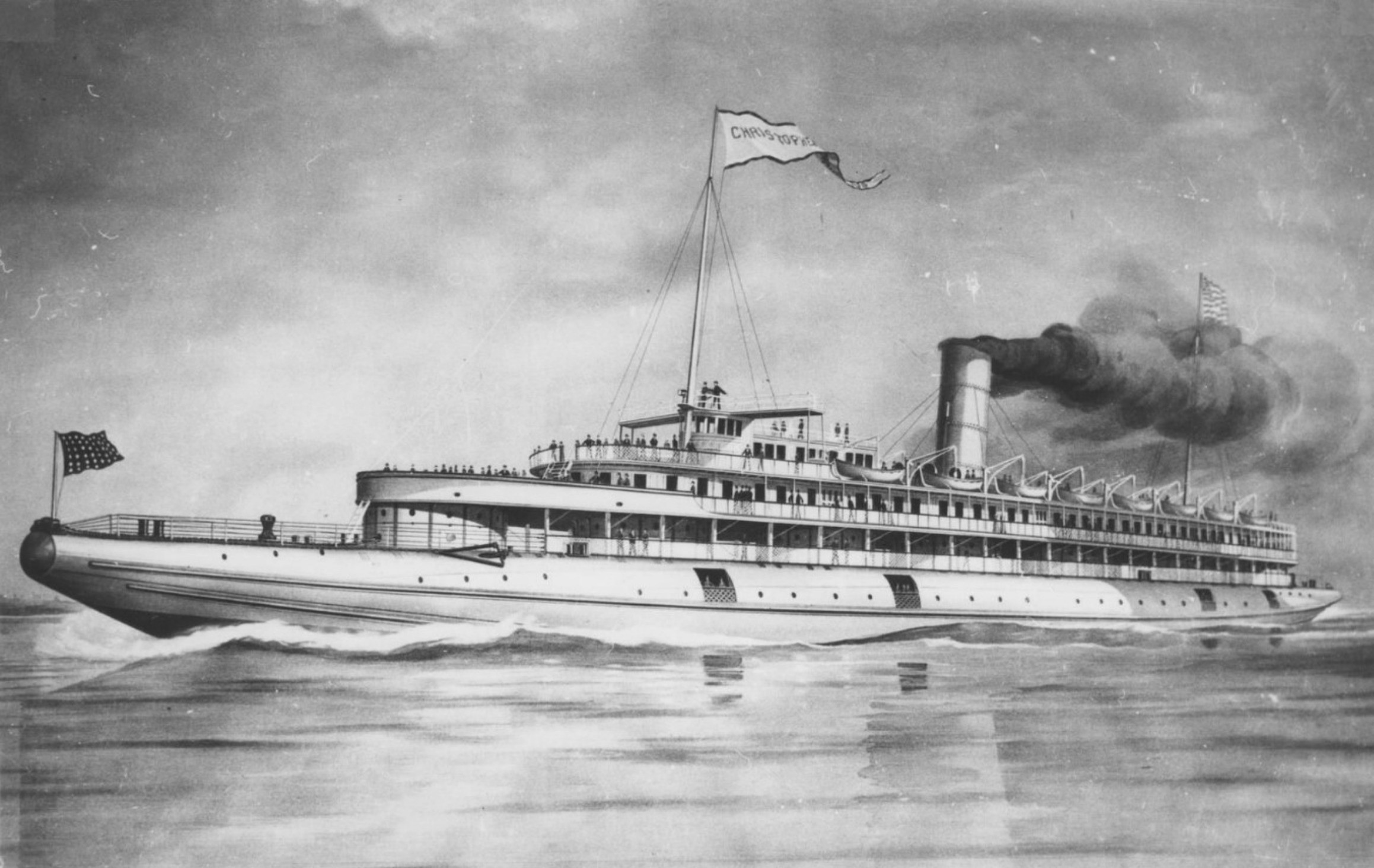
The first whaleback to operate beyond the Great Lakes was the 264-foot, self-powered Charles W. Wetmore, launched on May 23, 1891, in Superior and named for one of McDougall’s investors. That same year, in June, she sailed from Duluth with 95,000 bushels of grain for Liverpool, England, becoming the first whaleback to cross the Atlantic Ocean. The Everett-based Port Gardner News (Oct. 2, 1891) reported she had “…successfully made a trip from Duluth, Minn., in the heart of the American continent, across the Atlantic Ocean to Liverpool and thence back to New York… So successful has she proved from the beginning that the whaleback is now being loaded at New York for a voyage around Cape Horn to Puget Sound, in the Pacific state of Washington.” Alas, the following year, on Sept. 8, 1892, while carrying coal out of Tacoma, Washington, for San Francisco, the celebrated whaleback grounded in Coos Bay, Oregon, and was abandoned.
While no whalebacks were built in Canada, Port Arthur (now part of the city of Thunder Bay) was home port from 1912 until about 1920 to the whaleback Atikokan, launched in 1895 as the former John B. Trevor. The Canadian owner was the Canadian Northwest Steamship Company, owned by Port Arthur businessman Thomas Marks. She was later sold to the Canadian Steamship Lines and dropped from registry in 1926.
Only one whaleback was built on the Pacific West Coast. The City of Everett was launched on Oct. 24, 1894, at Everett, Washington. She became famous as America’s first commercial steamship to pass through the Suez Canal and circumnavigate the globe (1897-1898). The 346-foot ship was later converted to an oil tanker and, for many years, was operated by Standard Oil in transatlantic trade. On Oct. 11, 1923, she sank along with her crew of 26 in the Gulf of Mexico while carrying molasses from Santiago, Cuba, to New Orleans, Louisiana.
Today, there is only one surviving whaleback in the world—the S. S. Meteor, now a museum ship docked on Barker’s Island in Superior, Wisconsin. Launched in 1896 in Superior as the Frank Roosevelt, she was in service until 1969 under various owners. During her years of service, she was a lake freighter, sand dredge, auto carrier, and a converted tanker before returning to Superior in 1971 to become a museum ship. S. S. Meteor was added to the U.S. National Register of Historic Places on Sept. 9, 1974.