

When I was a youngster growing up in Thunder Bay, my father would go fishing in nearby streams with his rod and reel to bring back speckled trout for the family to eat. Later in life, I’d hear people talking about fishing for brook trout and, along the way, learned that the world’s biggest brook trout, weighing 14.5 pounds, was caught more than 100 years ago by Dr. J.W. Cook on the Nipigon River, which flows directly into Lake Superior. I didn’t think there was any connection between the names speckled trout and brook trout, but when I read an archived newspaper clipping that reported the Nipigon catch as the “biggest speckled trout in the world,” it made me question why the fish had different names.
Doing more research gave me an answer: Brook trout and speckled trout are the exact same fish biologically, a type of char belonging to the salmon family. The official common name is brook trout (scientific name Salvelinus fontinalis), while speckled trout is its widely recognized nickname. According to the Ontario Ministry of Natural Resources (OMNR) website, the official world record for the largest brook trout caught by rod and reel is still Dr. Cook’s catch on the Nipigon River, landed more than a century ago on July 21, 1915.
After learning that fish sometimes have official names and nicknames, curiosity led me to wonder which other fish in our Northern Wilds have alternate names. While colleague and Northern Wilds columnist Gord Ellis is the real expert on fish and fishing, here’s some fish-name trivia I’ve come across.
It didn’t take me long to find that rainbow trout and steelhead are both official names for the same fish species. Both are born in freshwater. While rainbow trout live their entire lives in cold-water lakes, streams, and rivers, steelhead are rainbow trout that migrate to large lakes such as Lake Superior to feed and grow before returning to freshwater streams to spawn. Though steelhead are native to the Pacific Ocean and its tributaries, they were introduced to the Great Lakes in the late 1800s. Today, Lake Superior steelhead are highly prized sport fish.
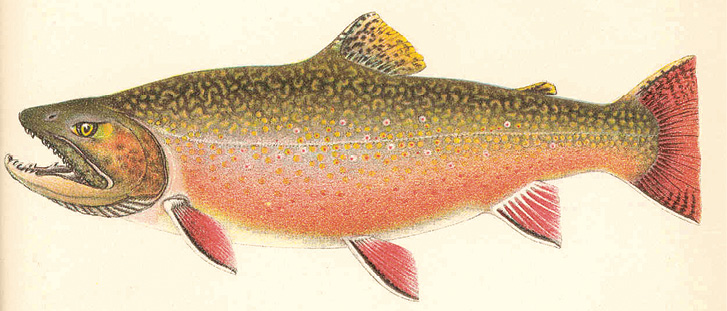
Even lake trout (Salvelinus namaycush), a large freshwater char, has several common alternate names depending on the region. These include siscowet in Lake Superior, mackinaw or mack in Canada and the United States, lake charr (or char), gray trout, laker, and paperbelly. The OMNR website lists lake trout as ranging from 12 to 31 inches (30 to 80 centimetres) and 2 to 10 pounds (1 to 5 kilograms), with the Ontario record standing at 63.1 pounds (28.6 kilograms). Lake trout are found in Lake Superior, Lake Ontario, Lake Huron, and deep, cold lakes across the Canadian Shield.
An excellent eating fish with an interesting history is the splake, a cold-water, hatchery-bred hybrid of brook trout and lake trout. Stocked in Ontario and developed by Canadian biologists in 1954, its name comes from the “sp” in speckled trout and the “lake” in lake trout. An aggressive fish, it’s also known by the nickname wendigo trout, a reference to the mythological cannibalistic creature in Algonquin folklore.
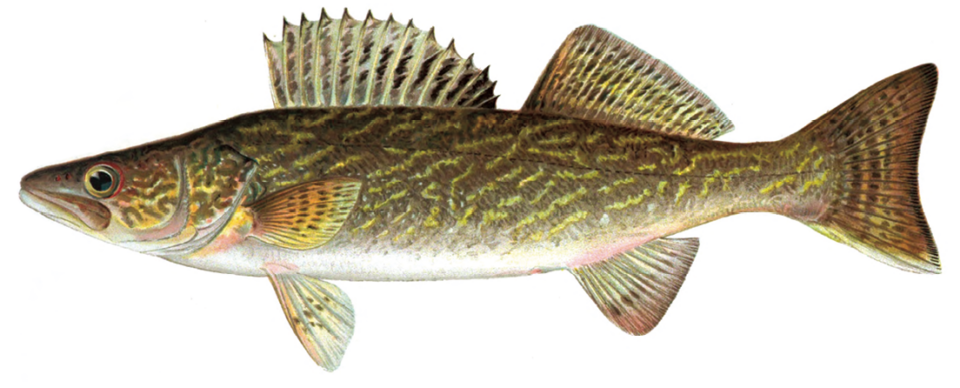
And lastly, what’s the debate about Ontario’s pickerel being a walleye? Are we talking about the same fish with two names, or two different species?
For generations, when Americans have said, “It’s a walleye,” Canadians have responded, “We call it pickerel in Canada; Americans call it walleye.” Have we been wrong all these years? Well, the short answer is yes.
The two fish are not related. They are biologically different species belonging to different fish families.

Walleye (Sander vitreus) are the largest members of the perch (Percidae) family. In French, the common name for walleye is doré, which means golden. Walleye can weigh more than 20 pounds and have a dark green back, golden-yellow sides, and a white belly. One of their distinguishing characteristics is the dorsal fin along their back.
The pickerel is the smallest member of the pike family (Esocidae) and is the common name for three closely related freshwater fish: chain pickerel, redfin pickerel, and grass pickerel. Native to eastern North America, true pickerel have long, torpedo-like bodies and rows of sharp teeth.
Going back generations, English-speaking Canadians have made pickerel the common nickname for walleye. One theory suggests that early English-speaking settlers in Canada referred to walleye as “pike perch,” which eventually was shortened to “pickerel.” As a result, the name pickerel became part of Canadian fishing culture.
Even today in Northwestern Ontario and Manitoba, restaurants offer “pickerel dinners,” and grocery stores sell walleye labelled as pickerel.
To find specific fish in a Canadian region or lake, the OMNR offers a free tool called “Fish ON-Line,” available online at home or as a mobile app.