
“So you’re a basket maker—did you study underwater basket making in college?” I often hear some version of this friendly joke when I introduce myself as a basket maker. If you’re unfamiliar with the “underwater basketry” idiom, it’s commonly used to refer to a subject that someone might study in college that is perceived to be absurd or totally useless.
The first time I heard the phrase was when I moved to Grand Marais about a year ago to be a resident artisan at the North House Folk School. The funny thing is, I had never heard the phrase before and had no reference for what the person was talking about. When I heard “underwater basket making,” I thought they were referring to making baskets that had the purpose of functioning underwater. I mistook “underwater” as an adjective describing the basket and not an adverb. We had a good laugh together.
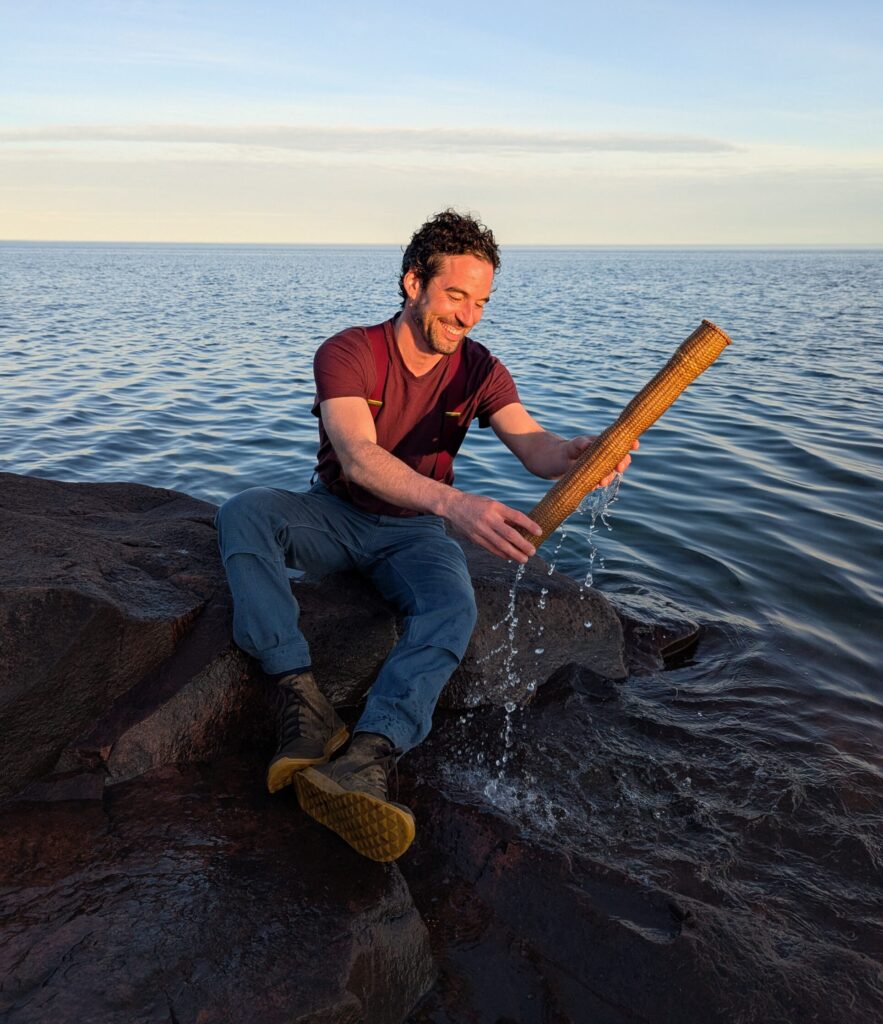
The truth is, underwater baskets are one of the most ancient and important technologies of our species. I’m referring to the great diversity of woven basket traps used to catch fish, eels, crabs, lobsters, and other water creatures. They provided our ancestors with plentiful and reliable sources of protein since the dawn of humanity; many scholars believe they even predate the invention of stone-tipped projectiles—i.e. spears. Underwater basket traps continue to this day to be woven and used by numerous cultures around the world, especially in East Asia and the Pacific Islands. Where they are no longer common, they’ve often only fallen out of use quite recently, within the past century or two.
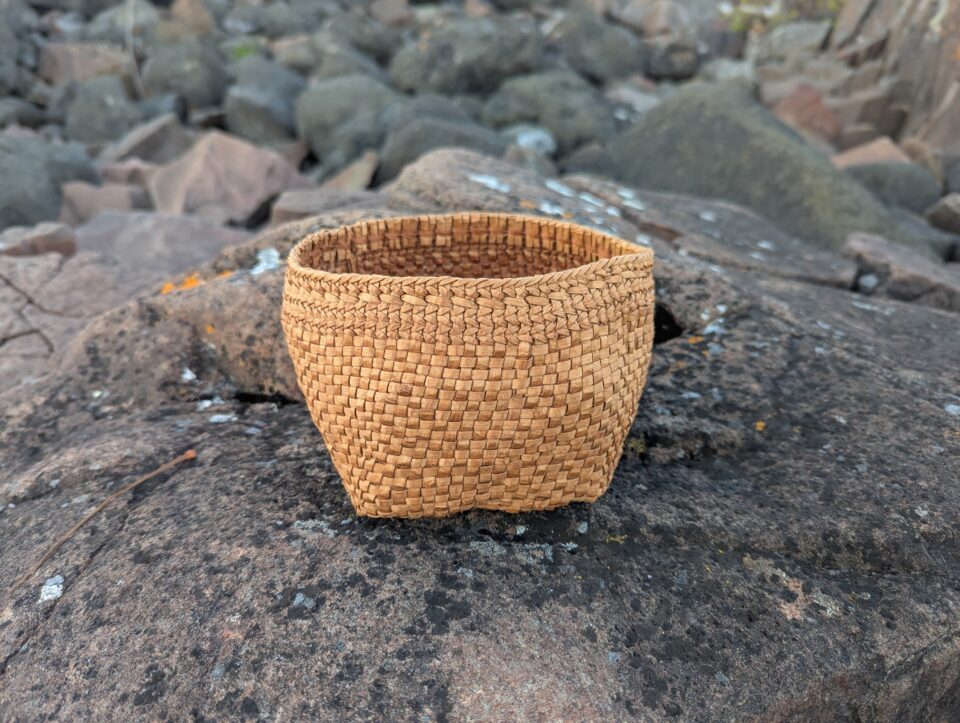
Although I love and am fascinated by fish traps, I’ve only made two in my life. Believe it or not, “eel trap maker near me” isn’t one of the most searched internet phrases in our area. I mostly make small, finely woven baskets from several types of tree bark and larger work baskets from split wood. What’s unique about these kinds of baskets is the materials cannot be purchased from any retailers or suppliers. In order to make baskets of this kind, you also need to be a basket materials harvester and processor. You need to be in relationship with the trees. Every basket I weave begins with a walk into the forest with an ax and a saw. My love and respect for trees—and gratitude for the many gifts they give up—has only deepened over the years. Through ongoing observation and relationship, I’ve become aware of how unwell many of the tree species in the forest actually are.
| SUBMITTED
With the endless abundance of cheap plastic containers and bags, we certainly aren’t dependent upon baskets in the slightest, nor the basket maker. But this is quite recent as well. Baskets were essential survival tools for the vast majority of human existence—not just to catch eels and catfish, but to transport and store everything. Because modern, industrial people aren’t dependent on locally made, bioregional baskets, we also aren’t dependent on healthy forests to source materials to produce them. In a globalized economy, the health of the local forest doesn’t affect the material lives of the average person in any meaningful way—or at least creates the illusions thereof. We don’t need baskets to live; our existence doesn’t depend on them, so the stakes don’t seem very high to us when the trees they’re made from are dying.
Said differently, there isn’t a material feedback loop with our bioregion. We materially feel industrial supply chain disruptions on the other side of the planet often before we feel the impact of a fungus or invasive beetle in the forest where we live.
Our lives are wholly dependent on healthy ecosystems, whether it’s immediately apparent or not. Ecosystems can collapse—and increasingly are—the world over. The United Nations estimates that up to 1 million species are at risk of extinction. One of the hallmarks of many of the most intact and diverse ecosystems globally is Indigenous sovereignty. This is, of course, because Indigenous communities have a deep, spiritually and culturally encoded recognition that humans need healthy ecosystems—and have a responsibility to ensure them for future generations. It isn’t something theoretical or abstract when a people have the knowledge and memory of being truly dependent on their bioregion for their material needs—for food, clothing, shelter, baskets.
I’m not suggesting, of course, that the solution is for everyone to go weave a basket. I’m suggesting that—with the utmost respect and humility we can muster—we individually and communally take steps to become dependent on the place we live, to materially be in relationship. Even better, let’s become interdependent. The forest and lakes need us too—not only to do less harm, but to be agents of healing.
By Ty Sheaffer
Ty Sheaffer is a basket maker in the Artisan Development program at North House Folk School, where traditional craft is taught on the shore of Lake Superior.