
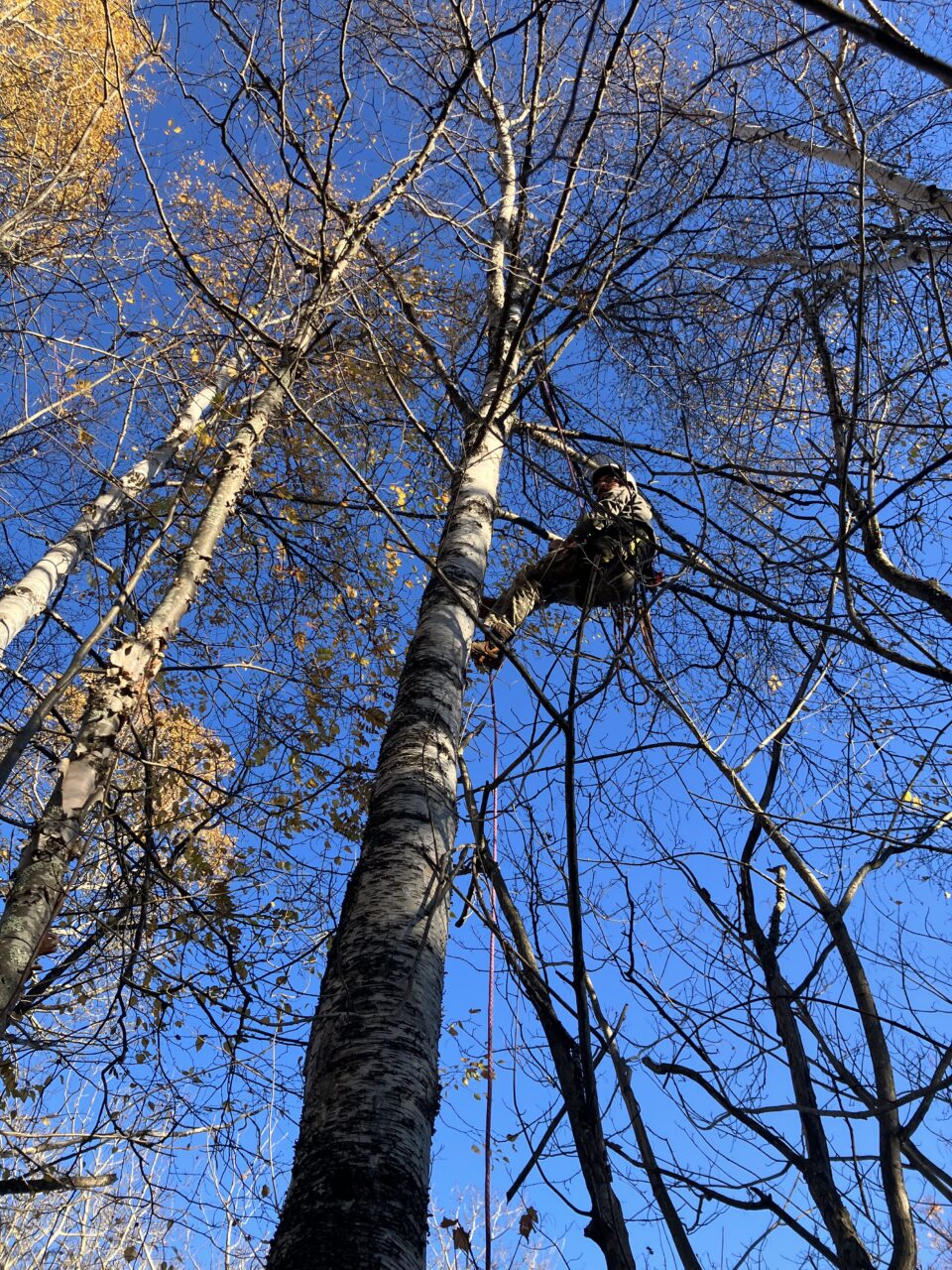
Philip Klobuchar is an owl. Or is he an osprey? Klobuchar works in tree canopies for a living, trimming out tree “windsails,” taking out dead limbs, or simply pruning trees at heights the rest of us would call “for the birds.” But here’s the extra catch—Klobuchar’s techniques are so low-tech, so quiet, and noninvasive—he’s like another one of the natural critters that inhabit tree tops. That’s because Klobuchar doesn’t use cranes, lifts, or other power tools commonly associated with tree removal. Instead, he uses old-school know-how—it’s called physics. Here’s how Treewalker Services is providing alternative tree care in Cook County.
“Just use a little bit of adrenaline, a little bit of brains, and go real slow.” That’s the formula Klobuchar employs in his daily work hanging out 80 feet above the ground in a harness tied into a rope. “Mistakes have to be nonexistent,” he adds.
The first step? Learning your trees. Klobuchar’s work starts with science because he needs to know which weight loads each tree species can bear, how each tree species recovers from injury, and what sorts of risks each tree species presents. “It’s important to be able to calculate those risks; I really enjoy the challenge behind it,” Klobuchar notes. “My work is mentally stimulating that way; I feel like I’m always learning new things about tree biology and the physics of what’s going on.”
Klobuchar has certification with the International Society of Arboriculture. He credits the organization for his continuous professional development. Last year, Klobuchar attended a workshop on the “physics of windsail.” This is an arboricultural technique that takes the “sail” out of a tree’s crown by trimming out overgrown foliage. The wind can thereby pass through the tree’s canopy more easily, minimizing potential storm damage.
“A lot of the arborists in Minnesota are adventurous types, but there’s science and education behind our work too, which is really fun,” says Klobuchar.
Klobuchar learned his trade from apprenticing with other arborists: “I was lucky—one of the earlier arborists I helped out was a very small operation. He did everything with ropes. He had a chainsaw for some bigger cuts, but mostly we used hand saws.”
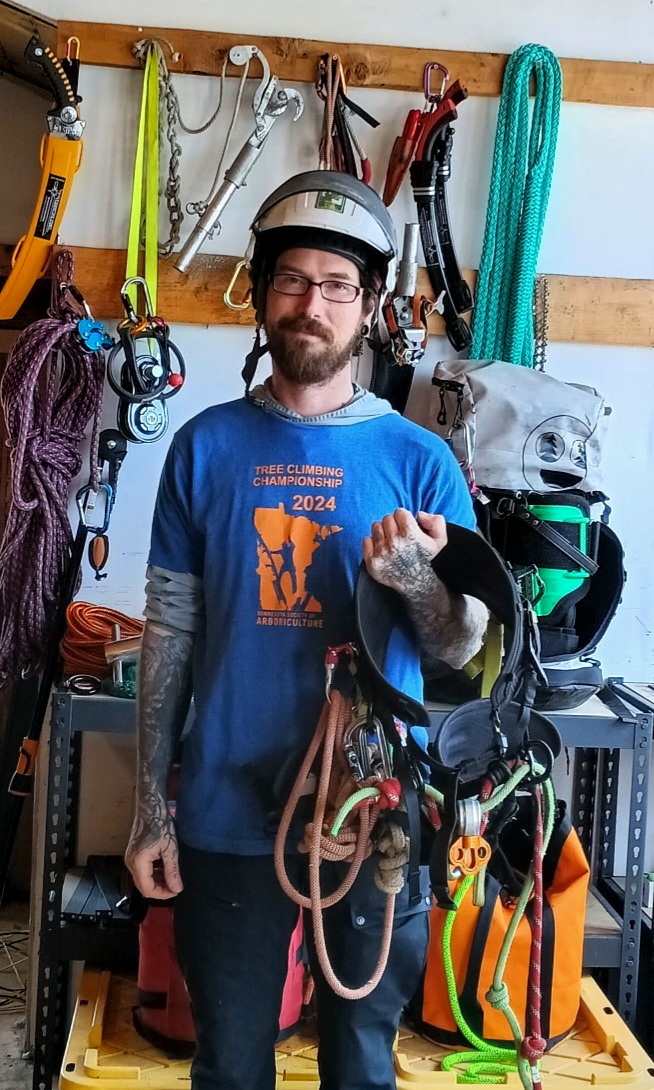
Now that Klobuchar is out on his own, he’s keeping this small-scale tradition going in his own practice. He sees his profession’s roots as overlapping with sailing: “It’s an age-old sort of practice with rigging and ropes. It goes back to nautical endeavors. Just two or three sailors could handle incredible amounts of weight with the right friction devices and an understanding of rigging techniques.”
Klobuchar got out on friends’ sailboats while growing up on Lake Superior and did some rock climbing at Wolf Ridge as a kid, but it wasn’t until he moved out west that Klobuchar became so enticed by the idea of climbing massive trees using ropes: “I had a friend who worked in redwood trees. I was doing wildfire suppression and construction out west at the time, but would pitch in as one of his ground crew cleaning up. Watching him, seeing the majesty of those titans, was enough for me to decide tree maintenance was the way to go.”
Treewalker Services is generally a one-person team, but Klobuchar also recruits help when there’s a lot of debris or cleanup that needs to happen. Rigging the devices is also best done with two people, Klobuchar explains: “It’s good to have someone on the ground who understands how the lowering devices work. Someone who knows what’s going on with the knots, knows the forces at work, and understands how the branch is going to swing.” Someday, Klobuchar says he would love to expand Treewalker Services and have one or two people who are regular helpers, but typically he’s swinging solo in the branches.
Klobuchar’s work at reducing/pruning tree canopies stimulates inner growth, providing fresh life to large or old trees. This will keep trees alive and stronger over time. For Klobuchar, his work is all about preserving and saving the mature giants.
So how does Klobuchar get up in a tree without a ladder or lift? “You start out with a very thin line that has a weighted bag on the end. And much like getting your bear bag up for camping, you throw that line up into the canopy. Based on the way that you sling it, you can actually get it 80-plus feet up in the air.”
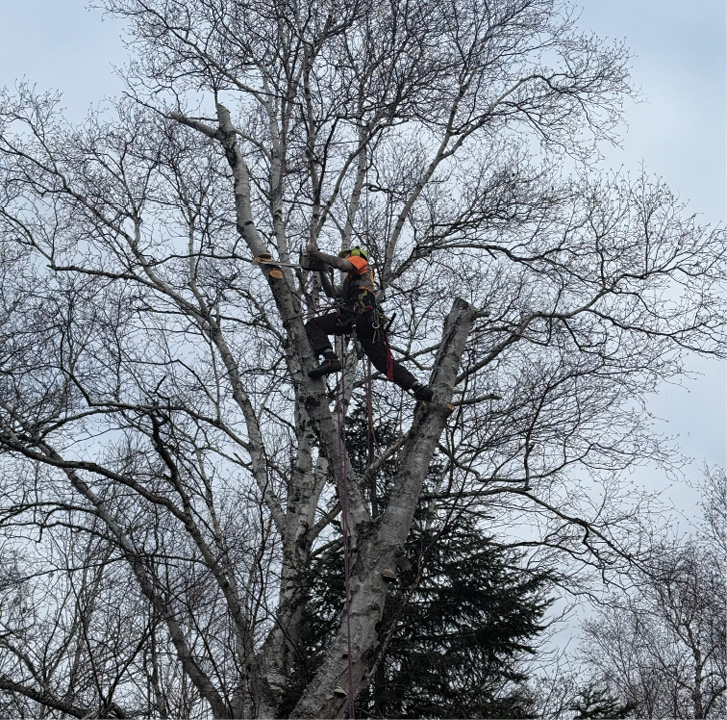
Klobuchar aims for a specific union of branches for the rope to lie on, what he calls his “central tie-in.” When the weighted bag falls through that union, Klobuchar then manipulates the way that it falls back down through the canopy to isolate a certain spot: “You can fish with the string until that weight falls through the path that you want it to take.” That way the line isn’t draped over a bunch of other branches or tangled all over the place. Once Klobuchar has his line in place, he ties a rope to it and pulls the line to get his climbing rope over the union. He then ties the climbing rope to the tree trunk using a running bowline. Climb on!
Klobuchar has several mechanical ascenders that he employs. They capture his progress ascending the tree, so they’ll slide up, but when pressure is applied downward—say, during a fall—they lock. Klobuchar sits in a harness/saddle called “TreeRex.”
“I’ve never found a tree I couldn’t get into, but I have certainly found a few that were incredibly frustrating,” recounts Klobuchar. Once he’s completed his ascent, he can get to work on his pruning cuts. He then employs friction devices to lower heavy limbs gently.
Sometimes the canopy sways so much in the wind that Klobuchar can feel the sway even back on ground: “It’s kind of like when you’ve been on a boat for the day and then feel the waves even back on shore. There are nights when I’ll lay down and I still feel that wind in the tree.”
One good thing about being so high up on windy days? No mosquitoes. “I don’t deal with ticks, and I don’t see mosquitoes very much,” laughs Klobuchar. “What I do worry about is bees.”
Klobuchar has done a lot of work in Cook County with maples, whether they be sugar maples, Norway maples, or autumn blazes. He also does a lot of structural pruning on birch trees that people want to keep around. He’s also worked on apple trees, crab apples, and white spruces, reducing the tree’s profiles.
Whether you have a decaying tree, an overgrown one, or you’re just concerned for the safety of your buildings and property, Philip Klobuchar has the solution. As he says, “It’s incredible what can be accomplished using physics alone.” You can reach Klobuchar by phone at 530-739-3754, or by email at [email protected].