

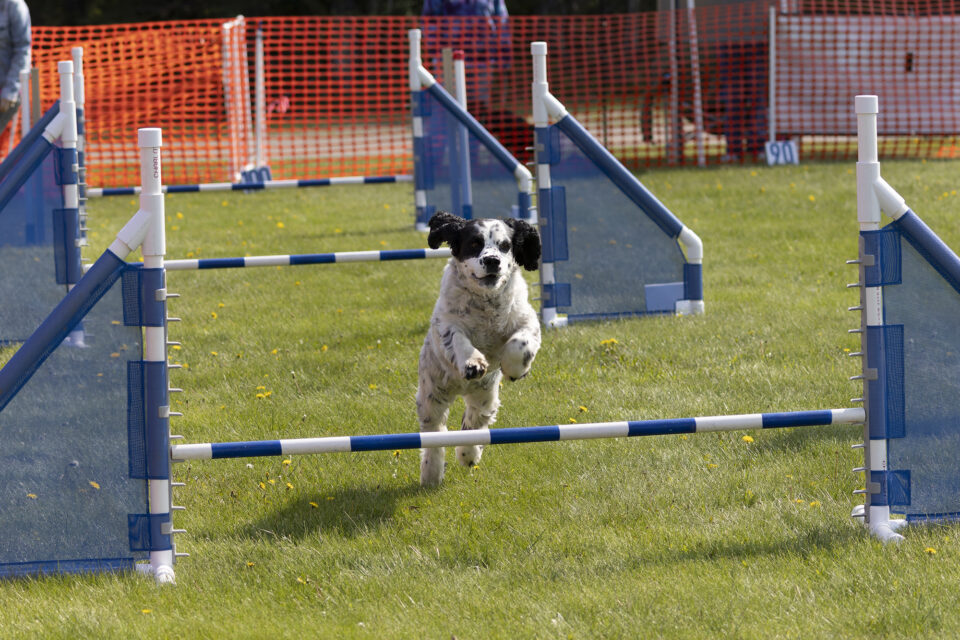
Dog owners interested in spending time with their dogs in a unique way should consider checking out the niche hobby of dog agility. Human handlers train their canine partners and then enter them into various competitions called classes, such as jumping or speedstakes, which emphasizes speed and removes all contact-based equipment.
A dog agility club in Thunder Bay called Sleeping Giant Dog Sports is running three dog agility trials in 2026, all at Chippewa Park, according to the club’s chair, Tammy Williams. “Trials are a great way to spend time with your dog,” says Williams.
One of the club’s agility events this year (May 30-31) may have already taken place by the time this article goes to print, but there will still be opportunities with a trial July 18-19 and another Sept. 12-13. Dog lovers, whether spectators or competitors, can combine their enthusiasm for competition, recreation, and above all else, dogs. “Trials are definitely addictive. It’s so much fun, for both me and my dog, and it’s great to watch as well,” says Williams.
According to Williams, different clubs in Thunder Bay run different trials. Her club runs two Agility Association of Canada (AAC) venue trials per year and one UK Agility International (UKI) venue trial per year, all at Chippewa Park. Dog competitors in both venues participate in obstacle course-style classes that include tasks like jumping and running through tunnels, among many other skills. There are different rules and course styles depending on the venue, as well as opportunities to earn titles and ribbons through the different organizations, according to Williams. For more details on the classes included in each trial, see the club’s website. “Our club has been running the AAC venue for six or seven years, and the UKI venue for the last four or five years,” says Williams.
“All of us agility enthusiasts here in Thunder Bay, when we first started running trials, there was only one in town (with the North American Dog Agility Council). We would have to go to Winnipeg, Sault Ste. Marie, or to the States,” says Williams. Since then, the club started from scratch with fundraising, equipment, and obtaining judges to run its trials.
One of Williams’ favorite things to share about the dog agility world is that, “Any dog can do it. We have a lot of mixed breeds and a lot of rescues,” she says. For example, the AAC is dedicated to the inclusion of all handlers and dogs, without regard for pedigree, as long as the participating dog can demonstrate the required agility, control, and skill needed for the various tests, according to the organization’s website.
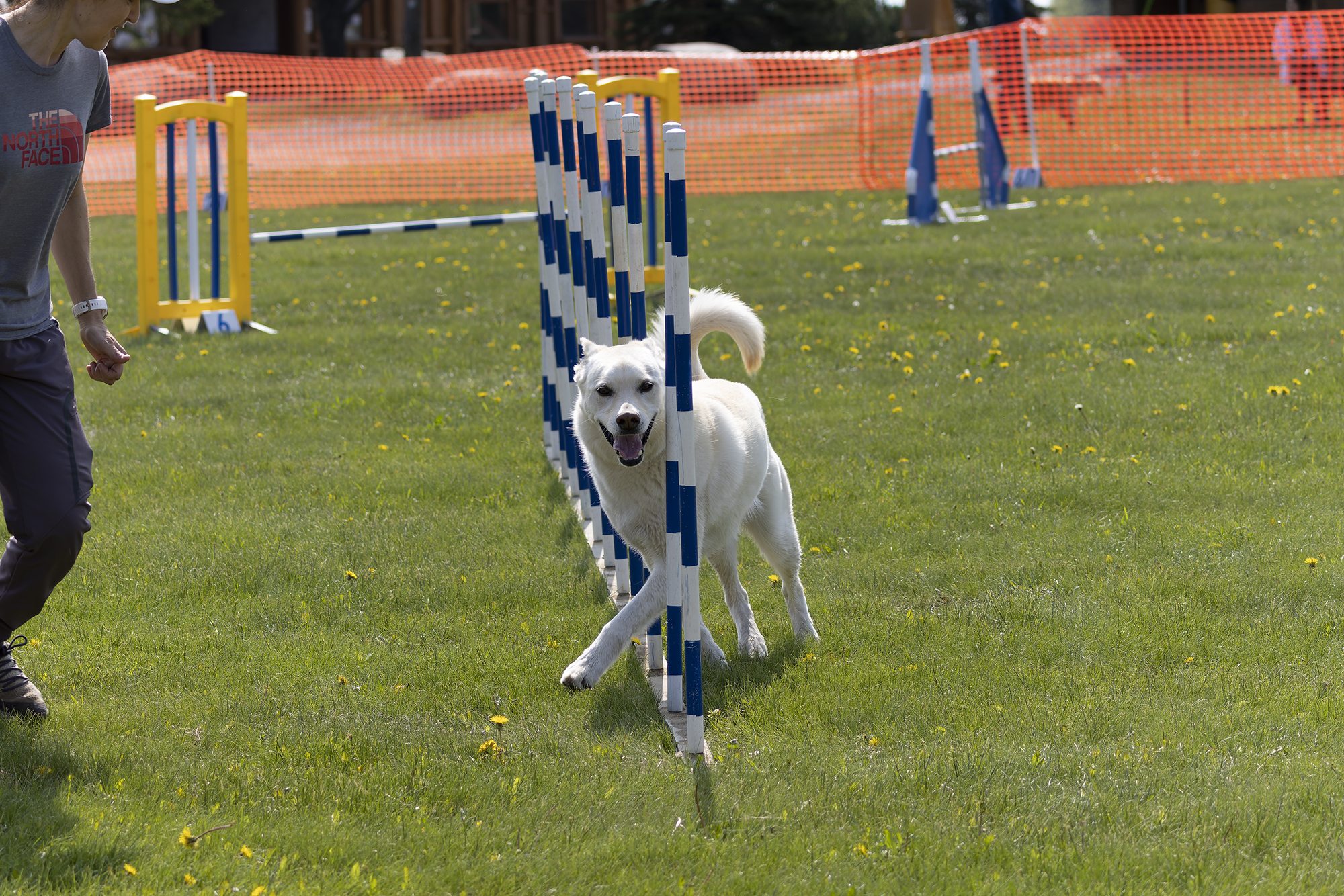
AAC’s overall philosophy is that the challenge and competition of dog agility should be enjoyed by all participants, including dogs, handlers, and spectators. “There is always a lot of connection between you and your dog,” says Williams. “And we welcome lots of spectators; you do have to stay a certain distance from the fence, though—even further away if you have a dog,” she emphasizes.
“Chippewa Park is just beautiful; it’s close to a campground too and you can walk right over. And we are right on the water,” says Williams. The setting adds to the event’s appeal, especially since both organizations emphasize fun and accessibility. The UKI strives to “create a friendly and relaxed environment for dogs, handlers, families, and spectators,” according to its website. Chippewa Park also hosts several other family-friendly summer events, such as a Kite Festival and a Children’s World Festival in June, and details can be found on the park’s website.
Another way to get involved with the dog trials is by volunteering at one or more of the events. “We could always use volunteers, helping with things like setting courses and equipment, sitting in the ring, and going out to set bar heights, etc.,” says Williams. The club can even sign off on required forms for high school volunteer hours. People interested in volunteering can email the club at: [email protected].
Competitors must jump through a series of logistical hoops to prepare for the trials. “To compete, you must register yourself and your dog, and you both have to be members of and registered with the particular venue organization,” says Williams. “And dogs have to be trained—you can’t just enter them without training,” she adds. There is a lot of training involved, according to Williams. “I run a local school where dogs can train on agility equipment—the club runs an agility training yard,” she says. Her enthusiasm for agility trials shines through. “The more people who want to play, the more we get to play!” she says.
This summer’s dog agility trials should offer plenty of opportunities for dog lovers to participate, compete, volunteer, or simply enjoy the sport.