

When the Centennial Conservatory opened in 1967, it marked Fort William, Ontario’s contribution to Canada’s centennial celebrations—a bright, glass-walled space where northern residents could experience tropical plants that many had only ever seen in books. For visitors in the late 1960s, the conservatory’s palms, hibiscus, and cacti would have felt genuinely exotic, a vivid contrast to the boreal landscape outside.
Over the decades, the conservatory became a familiar destination—a place for school and family outings, wedding photos, and mid-winter escapes. But by the early 2000s, the aging facility needed significant attention. Mechanical systems were unreliable, accessibility was limited, and some areas were off-limits for visitors due to structural deterioration and multiple safety concerns. The beloved conservatory was on the brink of demolition.
That was the state of things when landscape architect Guy Walter returned to Thunder Bay to join the city’s Parks & Open Spaces team. Instead of preparing for closure, he built a case for renewal that included a massive redesign. Walter said he envisioned a “completely different facility with more programming, events, and opportunities for research, innovation, and collaboration with community groups.”
While the city weighed its options, community members refused to let the conservatory fade from view. The Friends of the Thunder Bay Conservatory organized events, made deputations to council, and kept the issue visible online and in local media. As chair Sharon Sidlar explains, “For the past 12 years, our goal has been to make sure the public here was aware that there was a danger of closure.” In the end, she believes “it was a significant community response that convinced our city council that our public appreciates and treasures the conservatory, especially in our northern winters when a visit to the tropics is a welcomed respite.”
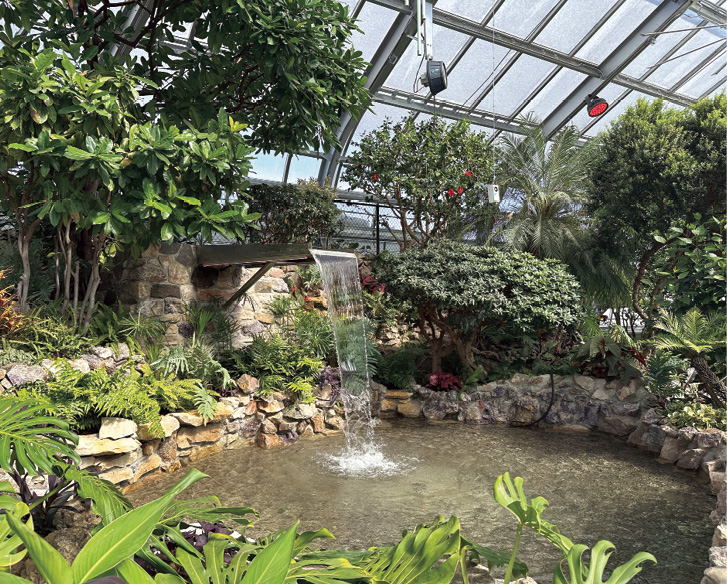
With phase one and two of the renewal project complete, the conservatory re-opened to the public in January, showcasing an upgraded entrance and walkways for accessibility, a reconstructed pond and waterfall, new accessible washrooms, a new west wing with redesigned cacti and succulent displays, and new and expanded production greenhouses. There are also spaces available for community use, which are truly multipurpose, having hosted board meetings, craft sales, and weddings—events that benefit from the conservatory’s lush backdrop and warm, natural light.
I visited at the end of March—technically spring, but very much winter on the North Shore. Outside, snowbanks towered over parked cars, the air temperature sat below freezing, and more snow was on the way. Stepping through the conservatory doors felt like stepping off an airplane in a tropical destination. As warm, humid air wrapped around visitors, I watched while they unzipped coats and peeled off toques and mitts and they settled in and strolled along the meandering walkways.
What many visitors don’t see is the work in the 950-square-metre (10,250-square-foot) production greenhouse facilities where staff grow roughly 150,000 plants (native naturals and annuals) each year, about 90 percent of them from seed. I was astounded when Walter explained that the conservatory supplies all of the plants that beautify the city’s parks, public spaces, boulevards, and nature-based stormwater infrastructure. He showed me the new state-of-the-art high-efficiency boilers and climate control and ventilation system that maintain optimal conditions for each growing area and described the 20,000-litre (4,400-gallon) rainwater collection and storage system that provides all of the facility’s water. In the new workshop area, Walter pointed out a large collection of canna lilies that had recently been taken out of cold storage. Many of the bulbs are more than 50 years old and, each summer, their bold foliage and flowers reappear throughout the city.
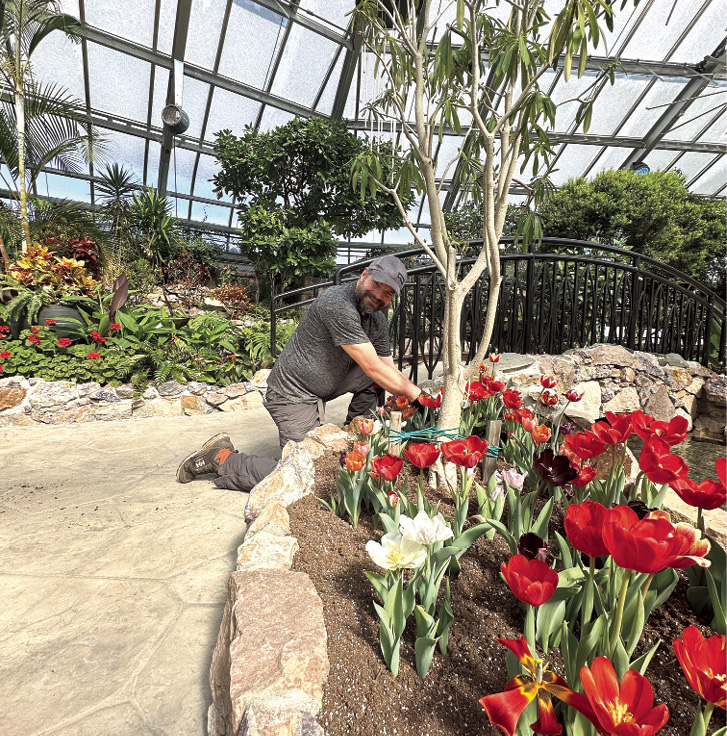
While admiring the tropical plants, I struck up a conversation with Charles Moore, who has worked at the conservatory for nearly a decade. He was tending a gorgeous bed of tulips when I asked about his favourite plants. Moore started with the crowd-pleasers, like the variegated agave, the powder puff tree (“like the plants in Dr. Seuss,” he told a young family), and the bird of paradise. It took a little coaxing for him to talk about his personal favourites, like the massive fig tree that he suspects may be as old as the conservatory itself. He also has a soft spot for the barrel cacti that were just beginning to bloom. “In May, everything will be thriving,” he said, adding that it’s one of the best times to visit.
Moore’s pride in the conservatory’s renewal is obvious. He beamed as he described the painstaking work required during renovations: “75 percent of the plants were moved—literally uprooted—including 99 percent of the cacti,” he said, still sounding amazed that contractors were able to protect and preserve the collection during such an intense construction stage. As we talked in the arid and succulent display area, I reflected on my last visit during the pandemic when this room was closed. The redesigned room is a huge improvement that features some of Thunder Bay’s history. Walter pointed out that the beds are built with cobblestones uncovered and salvaged from a road resurfacing project in the late-1990s—a detail that ties the conservatory’s renewal to the city’s past.
This summer, the final phase of the renewal project is set to transform the outdoor grounds into a botanical destination in their own right. Imagine a series of outdoor gardens (think pollinators and Indigenous medicines), ponds, and accessible walkways that flow from the indoor space. “Phase three will also encompass a dementia garden, which we’re developing in partnership with Lakehead University and Dementia Café,” Walter explains. The project also includes outdoor classrooms and a large outdoor venue overlooking Chapples Golf Course. It will be an expanded oasis in the heart of the city.
For Sidlar, the renewed space is personally meaningful. “I most enjoy the expanded space, in particular the cactus room that had been closed for too many years and is now spectacular,” she says. Looking ahead, she’s excited for the outdoor transformation: “New outdoor spaces to relax and enjoy and learn. This is truly special and unique.”
Walter echoes this sentiment and explains that the conservatory’s role as a refuge remains central, noting how important the space is for mental health. “If you spend time here, it’s pretty hard not to smile when you leave.” His involvement in the renewal has been deeply rewarding, “to play a role in making sure something with this much history isn’t lost—people don’t always realize the value of a place like this until it’s gone. Being able to help protect it and build it out for the future—that’s the meaningful part of my job.”
As 2027 approaches—the conservatory’s 60th anniversary—the renewed facility is more than a nostalgic landmark. It’s a working greenhouse, a community hub, and soon, a fully realized botanical campus that is rooted in its past and growing confidently into the future.
More information on the Centennial Conservatory can be found on the City of Thunder Bay’s website: thunderbay.ca.