The trail to the highest point in Minnesota doesn’t yield easily.
This winter marked the first phase of a multi-year rehabilitation project to replace aging boardwalks and a bridge along the Eagle Mountain Trail, one of Cook County’s most popular hikes. Much of the trail lies within the Boundary Waters Canoe Area Wilderness, a federally protected landscape in which motors and mechanized equipment are largely off-limits, leaving maintenance crews to rely on manual labor and traditional tools.
And there is nothing more traditional in a northern winter than a dog team.
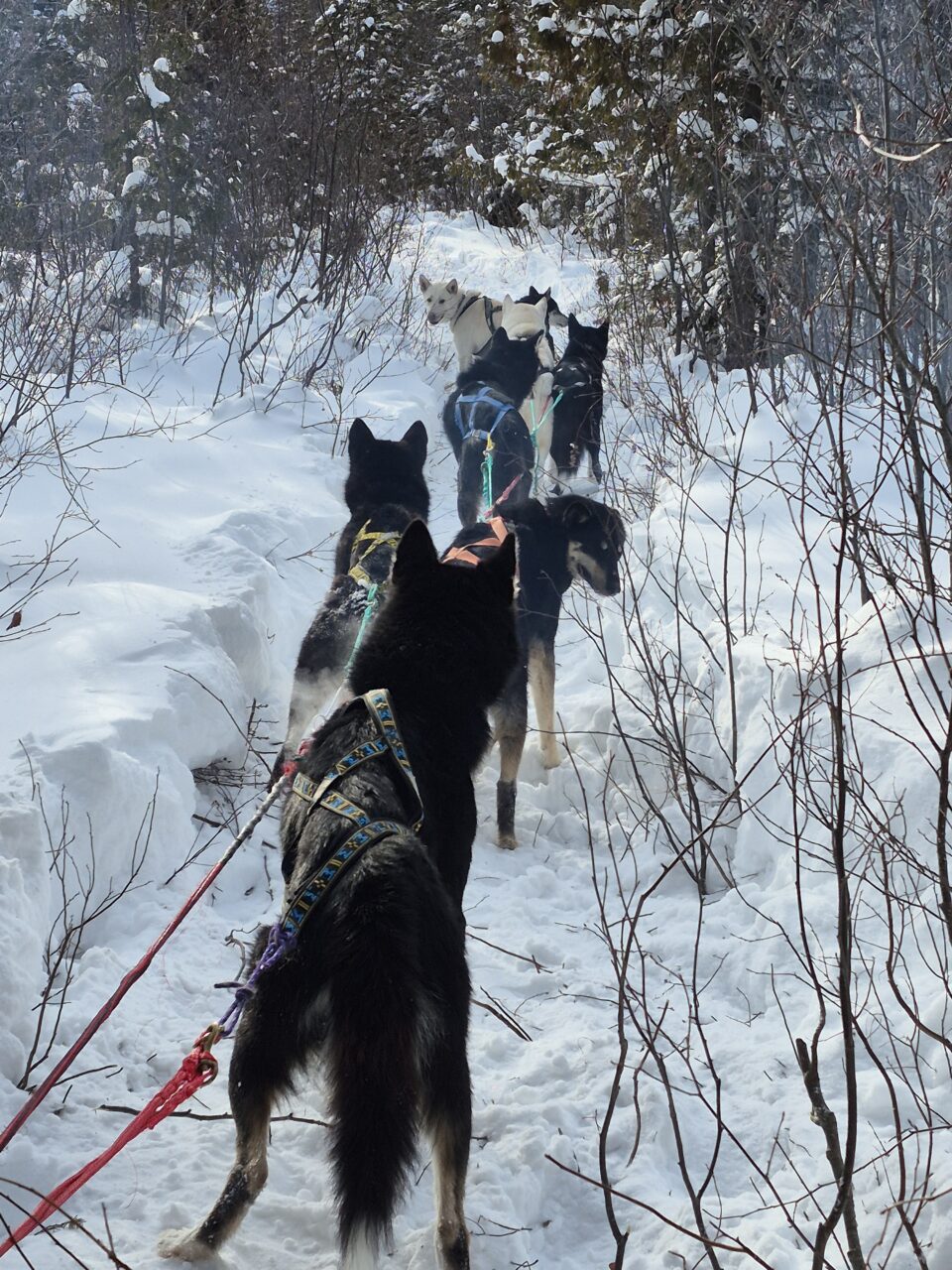
For the Eagle Mountain project, sled dogs were not just a nod to history; they were the backbone of the operation. Guided by musher Tom Roach, a U.S. Forest Service wilderness ranger based in Cook, Minnesota, the team hauled boards and beams across snow-laden stretches of trail that would have been nearly impossible to navigate otherwise.
For a few days in January, the trailhead sign carried a rare notice: closed.
Cathy Quinn, assistant wilderness program manager for the U.S. Forest Service, explained that closures are uncommon. “It’s rare that we actually close a trail,” she said. “But when we do, it’s usually for a safety reason—for employees, the public, or both.” In Eagle Mountain’s case, hauling lumber via sled dog team created a unique hazard. “Eight to 10 dogs pulling a sled can be 25 to 35 feet ahead of the musher. You can’t see who’s coming around the next corner,” Quinn said. “We just didn’t want any literal run-ins with the public. You’re on a snowy trail, it’s slippery, there’s deep snow. It was safest for everybody to pause access for a few days.”
Roach’s team, composed mostly of Alaskan Huskies, has been a cornerstone of the Forest Service’s winter operations. “He’s been a musher for decades, and we’ve been able to utilize his team for freighting, patrolling, and maintenance missions,” Quinn said. In fact, the Forest Service has run a mushing program since the 1990s, using dogs for tasks like hauling materials from remote locations, including past projects such as removing the old Brule Lake fire tower.
“For Eagle Mountain, it took roughly 10 employees over four days and 30 trips to haul all that material,” Quinn said. “By foot, with human crews alone, it probably would have taken weeks, and the risk of injury would have been higher.” Winter’s frozen terrain, deep snow, and uneven ground make sled dogs ideal. They are built for endurance, strength, and teamwork in conditions that challenge humans.
Preparation for the dog-powered mission was intense. Staff spent three days cutting, organizing, and staging boards and beams. At any given time, a single dog team ran, while the rest of Roach’s roughly 30 dogs stayed engaged nearby. Quinn laughed, “Sometimes they get bored running the same trail over and over again, but this group stayed motivated the entire time. They were just a joy to work with.”
While the dogs’ primary task was hauling lumber, their presence also supported trail management and patrol. As the teams moved materials, they scouted trail conditions, checked for erosion, and made contact with winter campers. “Winter camping can be destructive if you don’t know what you’re doing,” Quinn said. “So, we use these missions to patrol and educate the public while also completing necessary maintenance.” The dual purpose of freighting and patrolling showcases the flexibility and value of using sled dogs in wilderness operations.
The Eagle Mountain Trail itself presents unique challenges. The summit is Minnesota’s highest point, drawing significant foot traffic. Before reaching the peak, the trail crosses streams, marshes, and other wet areas where boardwalks are essential. Erosion, water damage, and heavy foot traffic have compromised multiple sections, requiring a careful stewardship strategy that will unfold over several years. Quinn explained that these projects are planned meticulously with partners such as the Boundary Waters Advisory Committee (BWAC) and Friends of the Superior National Forest, who contribute volunteer labor and coordination.
Throughout projects such as this, the sled dogs remain crucial. “They’re not just working animals,” Quinn said. “They’re part of the team. They know their work, they’re intelligent, and they keep everything moving efficiently.” Ensuring the dogs are fed, hydrated, and rotated through the line requires constant attention and expertise. “It’s a lot of work outside of the trail, too. Training, feeding, and conditioning are critical so that when they hit the trail, they perform safely and effectively.”
The dog teams’ success is a reminder of how non-mechanized tools remain relevant in modern conservation. “This is a traditional way of travel that’s still incredibly effective,” Quinn said. “It’s not broken. Why fix it?”