
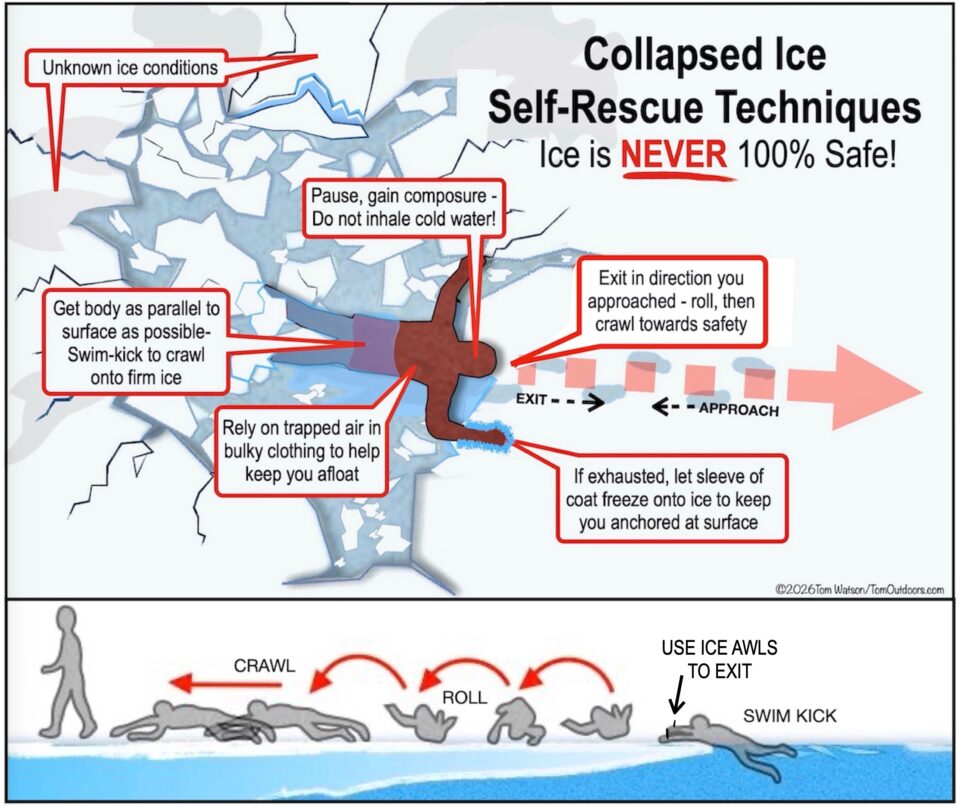
The cardinal rule for any and all activity on frozen lakes or streams is: “Ice is never 100 percent safe.” The qualities of ice can vary within just a few feet. The sudden collapse of what may seem like a good, solid surface can happen in an instant. Quick thinking and a sequence of self-rescue maneuvers can help minimize the physical and mental shock of plunging into freezing water.
There are three critical stages of self-rescue after falling through ice. Designated as the 1-10-1 Rule, the first stage is perhaps the most critical. It’s the initial chilling, body-shocking response to being submerged in ice-cold water. A victim has a tendency to frantically tread water while gasping for air or inadvertently swallowing ice-cold water.
As hard as it may seem, it’s best to use the first minute (the first “1” in the rule) to concentrate on staying calm, pausing, and collecting your thoughts. The human body can function for about 10 minutes (the second stage, “10” in the rule) before muscles succumb to the cold. It’s during this stage that quick, focused action can enable you to initiate a self-rescue by regaining your composure.
Hypothermia doesn’t set in immediately. The last “1” in the rule indicates the number of hours a person can survive before becoming hypothermic.
Steps for Self-Rescue After Falling Through Ice
- Once calm, face the direction from which you were coming when the ice gave way. You know that route is safe having just traversed it. You have no way of knowing how good or bad the ice is beyond the spot where you fell in.
- Leave heavier clothing on, as any trapped air will provide some buoyancy. Avoid carrying any protruding accessories or small fanny packs on your front side, as they can catch on the ice edge and prevent you from sliding back up onto the surface.
- Position your body as parallel to the surface as possible, rather than hanging vertically as if trying to do a pull-up to get out of the hole.
- Kick with your feet and legs like you are swimming, thrusting yourself upward and forward to get back onto solid ice.
- Carry ice awls or picks and use them to help grab the ice and pull yourself forward as you kick.
- Always try to keep your arms and sleeves out and up on the ice at all times. In a worst-case scenario or failed self-rescue due to fatigue, your coat or sleeve can freeze to the ice, helping hold you partway out of the frigid water, should you become unconscious or physically incapacitated. This also aids rescuers in locating you if you slip below the surface.
- Once your body is fully on the ice, start rolling slowly but steadily along the surface away from the hole.
- After a few yards, if the ice appears solid, carefully rise to a crawling position and continue on your hands and knees in a safe direction—back from where you first came—toward safety.
- Gradually rise to your feet and seek warmth and shelter immediately.
- If you are aiding in a rescue of a victim, approach carefully by crawling close enough to extend a branch, pole, rope, or other object they can grab. In some cases, offering a looped rope (often tied using a bowline knot) can be fitted over the victim’s shoulders or upper torso to secure or retrieve them back onto the ice and away from further dangers. Avoid making direct contact, as a panicked victim may unintentionally pull you in while attempting to climb on top of you.
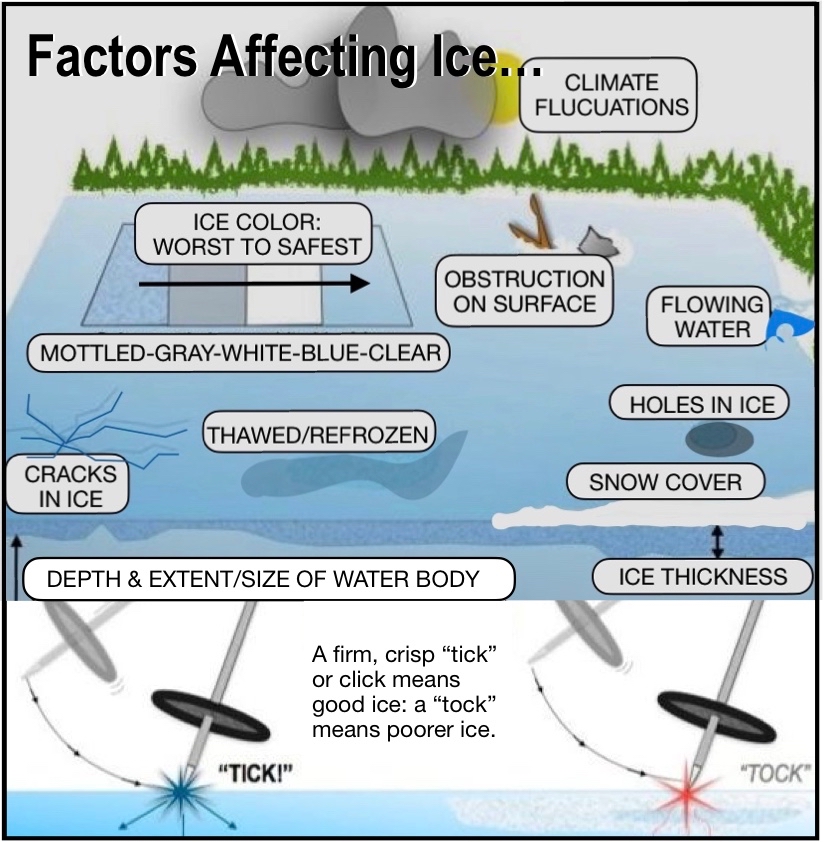
Whether you’re cross-country skiing, snowshoeing, skating, or simply enjoying the quiet solitude of a walk along a frozen pond, always consider and respect the multiple characteristics of ice. Be prepared, remember the 1-10-1 Rule, and be aware of its sometimes deceiving Jekyll-and-Hyde personality.