“Fiber is necessary,” said Marlys Johnson, past president of the Northwoods Fiber Guild. “The practice of working with fiber is so old. It was necessary to live. It was necessary to clothe yourself. It was necessary to stay warm. It may not be technically necessary anymore, but the drive to create something with your hands is still there.”
That belief, that fiber meets a deep human need, has guided the guild since its founding in 1988. For nearly four decades, the guild has brought together people working in weaving, felting, spinning, stitching, papermaking, dyeing, and related forms. What unites those practices is not a single technique, but a shared understanding that making by hand creates connection, reflection, and community.
“Fiber brings people together,” Johnson said.
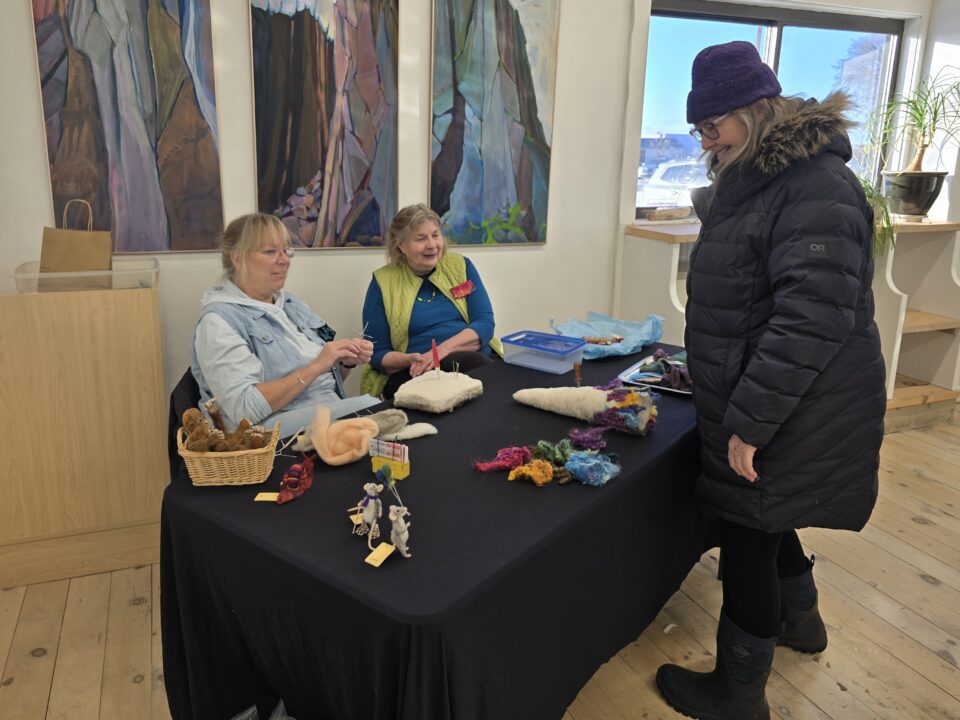
That focus will be on display in the guild’s upcoming exhibition at the Johnson Heritage Post Art Gallery in Grand Marais. Opening January 30, the exhibit highlights the range of fiber work being done across Cook County, with a particular focus on a collective project called the Hope Chair. The guild will also host a show and share at North House Folk School on Saturday, February 15 at 7 p.m., an opportunity for participants and instructors from NHFS Fiber Week to showcase past and current projects.
The Northwoods Fiber Guild currently has between 40 and 50 members, including a few from Thunder Bay. Members meet bimonthly at The Hub, which also houses the guild’s library and historical records. Study groups meet regularly, sometimes once a month and sometimes twice, focusing on felting, weaving, spinning, papermaking, and needlework.
“There’s a really wide range of techniques that are pursued,” Johnson said. “You can’t just say someone is a weaver. It’s always, ‘What kind of weaving are you doing?’”
The guild’s work often extends beyond meetings and study groups into partnerships with other community organizations. A long-standing relationship with North House Folk School includes hands-on family activities during the Wooden Boat Show, open houses during Fiber Week, and volunteer support for classes. Several guild members teach at North House, while others assist with children’s programs.
“People love to share their interests and their skills,” Johnson said. “That’s a real core part of the guild.”
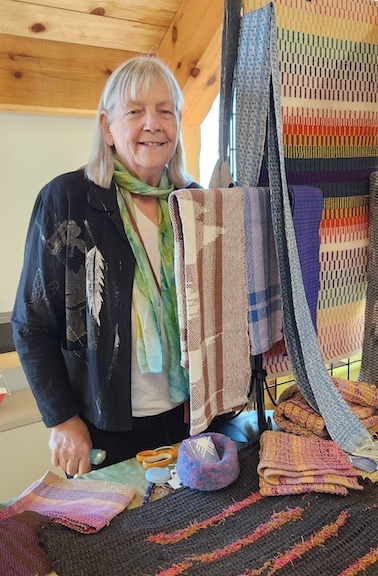
That generosity also shows up in public art and service projects. When North House renovated its Yellow Building, the school asked the guild to help soften the visual impact of construction fencing. Guild members responded by weaving directly onto the fences throughout the summer.
“I was down there weaving several evenings,” Johnson said. “It was fun to have people walking by who just wanted to chat. Everybody had their favorite parts.”
The guild has also made reusable fiber bags for the Cook County Public Library, providing an alternative to plastic or paper. “The library lets us know when they’re getting short, and then we make more,” Johnson said. “That’s been going on for many years.”
One of the guild’s most memorable projects was the Felted Forest, an outdoor installation of felted animals and plants placed in the small forest to the south of Sawtooth Elementary School. Created by the guild’s felting group, the project evolved over time and became a favorite for families and school groups.
“We started with a few creations and kept adding,” Johnson said. “Kids loved discovering things.” The work even interacted with wildlife. “Someone actually saw a fox with a felted animal in its mouth,” she said.
The Hope Chair, which will be a centerpiece of the guild’s upcoming JHP show, grew from that same spirit of shared making. The idea emerged after guild member Cheryl Larsen presented a program about the Dream Chair, a South African project that invited people living with AIDS to bead their hopes for the future onto a chair as part of a collective artwork.
“I was in the audience listening and thought, ‘Wouldn’t that be fun to do something like that here?’” Johnson said. “It was February 2025. We were just entering a really chaotic period, and it was hard to stay focused or hopeful.”
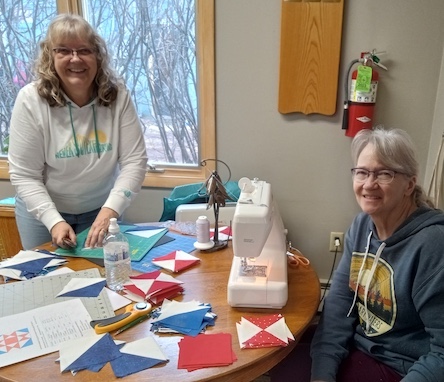
The guild invited members and community participants to contribute fiber pieces reflecting hope, with minimal restrictions. “We didn’t want to limit it to squares or to one kind of fiber,” Johnson said. “We wanted it to include all fiber arts.”
At first, submissions were slow. To make the idea tangible, Johnson purchased a chair from Oddz & Endz for the guild’s December open house at Studio 21. “Once people could see it, it clicked,” she said. As of now, 24 people have contributed pieces that will come together as the chair’s upholstery.
“It’s interesting to see how many different kinds of pieces come together,” Johnson said. “It reflects how we can work together if we’re paying attention and listening. There’s patience involved, and persistence.”
Each contributor is also asked to submit a journal entry describing what they were thinking while working. The journal will accompany the chair during the exhibition, and the long-term goal is for the chair to travel throughout the community and the county. “People could sit in it for a while and maybe write something themselves,” Johnson said.
The guild operates with a small budget and a strong volunteer ethic. Membership is $25 per year, with options for those who need assistance. The only fundraiser is the December open house and sale, and the guild also offers scholarships for classes, asking recipients to give back simply by sharing what they learned.
For many members, fiber remains both practical and deeply personal. “As you’re creating, you’re also thinking,” Johnson said. “It’s a meditative experience. It’s regulating. It requires discipline and organization.”
That quality, she added, helps explain why fiber has endured for thousands of years. “Now it’s necessary in a different way. Making something with your hands, putting yourself into it, and then using it or giving it away, that’s what makes it special.”