As the cold winter wind blows snow in from the north, mushing season is just heating up.
Sled dog racing is a staple of northern Minnesota culture—an homage to a time before roads traversed the Northern Wilds, and the fastest mode of winter transportation was behind a team of eager canines ready to work the snowy trails.
The WolfTrack Classic is a fun, family-friendly race held each February in Ely that attracts mushers from all across the Midwest and Canada. The race is organized by the Ely Chamber of Commerce and made possible by a number of enthusiastic volunteers and sponsors.
Ely has a rich history of sled dog racing, dating back to the All American Sled Dog Championship race, first held in 1970. It grew quickly in popularity, and soon thousands of visitors traveled each winter to watch mushers compete in the All American until it disbanded in the early 1990s. In 2008, the WolfTrack Classic returned the sport to a community ready to celebrate it once more. The race is one of only three sled dog competitions currently active in the state.
“Our race is the smallest and typically features a diverse group of mushers, ranging from professionals to recreational participants, handlers, and youth,” explains Eva Sebesta, Race Coordinator and Executive Director of the Chamber. “The youngest musher ever was 11 years old.”
Sebesta worked as the volunteer coordinator on the WolfTrack Classic’s original independent board in 2016, and she continued after the Ely Chamber took control in 2019.
Two mid-distance races make up the WolfTrack Classic, both beginning in Ely. The eight-dog race travels 50 miles along the Taconite Trail and through Bear Head Lake State Park before looping back to Ely, and the shorter six-dog race also follows the Taconite Trail, ending 30 miles away in Tower. “We usually have 40 to 45 teams run the race,” Sebesta says, and they can accommodate up to 60 mushers.
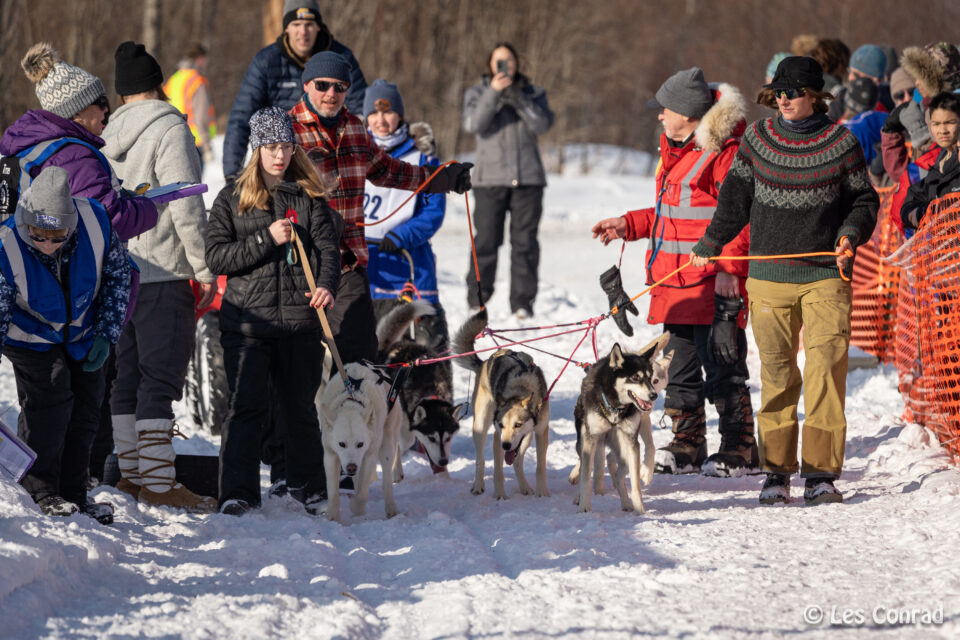
Excitement fills the streets on race day as dogs, mushers, volunteers, and spectators ready themselves for the big event.
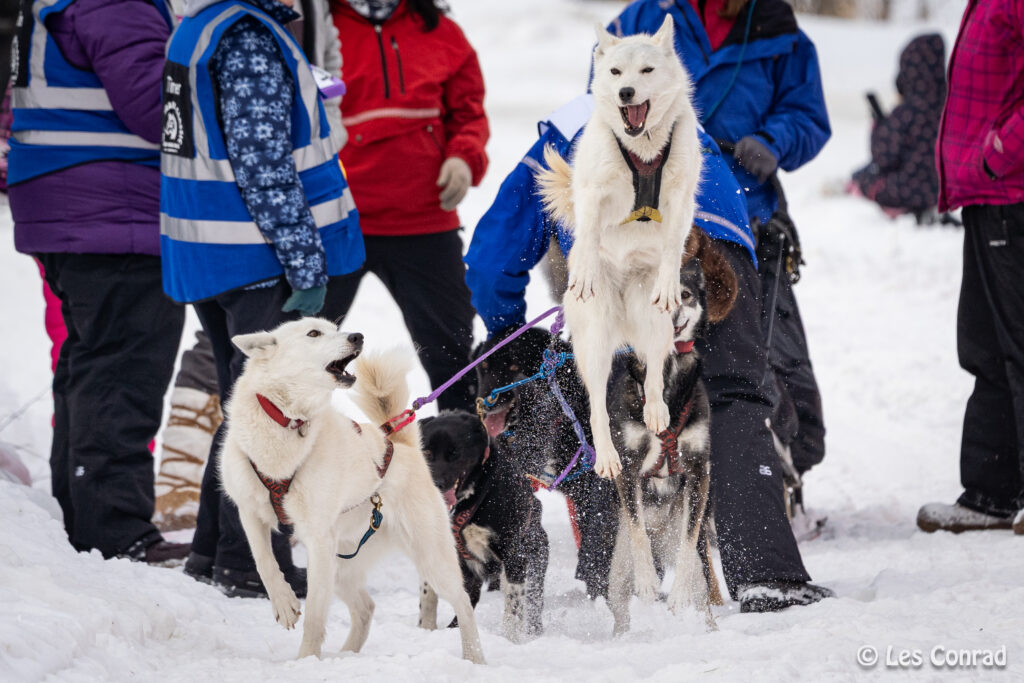
“Musher trucks arrive between 6-7 a.m. on Sunday morning,” Sebesta says, setting the scene. “Across all the teams, we have several hundred dogs who all begin barking, howling, and bouncing up and down (bangers). It sounds like absolute chaos, and the energy is palpable. Once the teams start into the line-up (In the Hole, On Deck, Start Line), there is a wild energy as each dog starts leaning into its harness, ready to hit the trail. Once the team starts, a silence falls over it, and the dogs begin to focus on the trail and race.”
Long before the first sled takes off, a small army of volunteers is trained and stationed at checkpoints and trail crossings to help mushers travel safely.
“We typically have between 120 and 150 volunteers helping at road crossings, safety points, the start-finish area, and with handlers, communications, and parking,” Sebesta says. “It is a huge undertaking to make sure that we have enough people covering every location and position. Safety is our top priority, encompassing our mushers and teams, spectators, and volunteers.”
“We do tailgate training for our handlers, parking, and road crossings,” Sebesta explains, requiring a minimum of one or two sessions prior to the race and on race day, “depending on volunteer availability.” An experienced person is typically assigned to each group to maintain safety and guidelines.
Volunteers are recruited from the Minnesota North College–Vermilion campus, other local groups, and online using social media, and around 30-50 people return annually.
“We have developed so many strong friendships with our core volunteer group,” Sebesta says. “For a number of those individuals, we are communicating throughout the year.”
Volunteers enjoy working around the dogs and seeing them run. “These canine athletes are just like marathon runners,” Sebesta mentions. “They love what they do, and the excitement and energy are almost overwhelming.”
Sebesta appreciates all the volunteers, mushers, sponsors, and spectators who make the event possible. The mushers, she says, “are the salt of the earth.” They have a special bond with their team, which you can see “at the start and finish of the race as they go and embrace each dog.”
Aspects of the race can be dangerous and unpredictable. Snowy and icy conditions are challenging, and mushers and volunteers must be ready for anything.
“One of the first years I worked with a race, a dog got loose from the musher’s gangline and was running full tilt in front of the team,” Sebesta shares. “Our Race Marshal, Stan Passananti, went from having a conversation with another race official to tackling the dog in a blink—it was incredibly impressive.”
In addition to the race itself, participants and visitors are welcome to attend a food and music event called the WolfTrack Prance, held at the Grand Ely Lodge on Friday, Feb. 20, from 4 to 7 p.m. Guests enjoy a special pay-your-way menu, cash bar, live music, and door prizes.
On Saturday, Feb. 21, the public is invited to meet the teams from 3 to 5 p.m. at the Minnesota North College–Vermilion campus, and attend a spaghetti dinner fundraiser hosted by the Wilderness Club from 4 to 6 p.m. Race day is Sunday, February 22, with the first team hitting the trail at 9 a.m. An awards ceremony takes place at Grand Ely Lodge after the last team finishes the race.
If you would like to volunteer for the WolfTrack Classic, Sebesta says to visit their website (wolftrackclassic.com) and check out the volunteer section on the front page. You are also welcome to reach out to her directly with questions by emailing [email protected], or calling 218-365-6123.
Happy trails!