

It’s a mood thing. The mood in gameplay is generally competitive, so it takes a special kind of mood to want to play a cooperative game. And right now, for various reasons, it seems few are in such a mood—at least in the context of cooperative chess. There’s too much of a fight going on in real life.
In this fight we do sometimes find cooperation, but it’s a conflicted cooperation. It’s a cooperation for the sake of the fight, because cooperation with good requires a non-cooperation—or a fight—with bad. The big question is, who gets to decide what’s right and what’s wrong? Who gets to set the terms and then enforce them? It’s a wrestling match on top of the basic fight to survive, and it’s a fight that has gone on for centuries without having been fully resolved by any of the world’s institutions, movements, or philosophies.
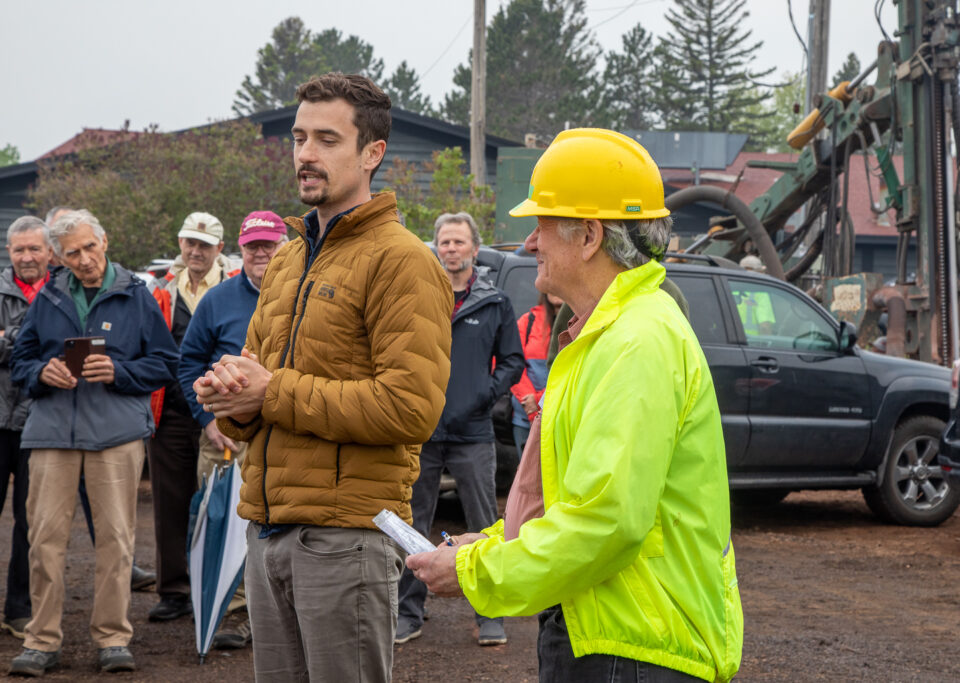
So, when the call went out to local business leaders to play DUO, a version of chess that calls for cooperation rather than competition, for an atmosphere of partnership rather than one of conquest, in which the thrones and crowns are cast aside in a spirit of camaraderie and mutuality, the response was mostly silence. One person, however, did respond: Jason Hale of North Shore Development Company (NSDC).
Hale is someone already accustomed to playing a kind of cooperative chess in real life. Before founding NSDC, a consulting and development firm centered in Duluth, Hale worked in local government in various roles along the North Shore, most recently as the executive director of the Cook County Housing and Redevelopment Authority. While there he, among other things, helped secure the resources needed for building two new apartment complexes in Grand Marais: Gunflint Vue and The Heights. He also once showed up at a Grand Marais City Council meeting with candy for the councilors.
Now, at the head of his own business, in what ways is he playing cooperative chess, and in what ways must he play competitive chess? How is he reconciling the competition needed to succeed in business with the cooperation needed to support a community? These questions were to be discussed over a game of DUO at a local coffee shop or brewery. The pitch was, “Think YouTube show Hot Ones meets Barnes & Noble, except that instead of milk and hot wings there might be beer and popcorn, or coffee and scones, and all without the excruciating pain—hopefully.” Hale accepted.
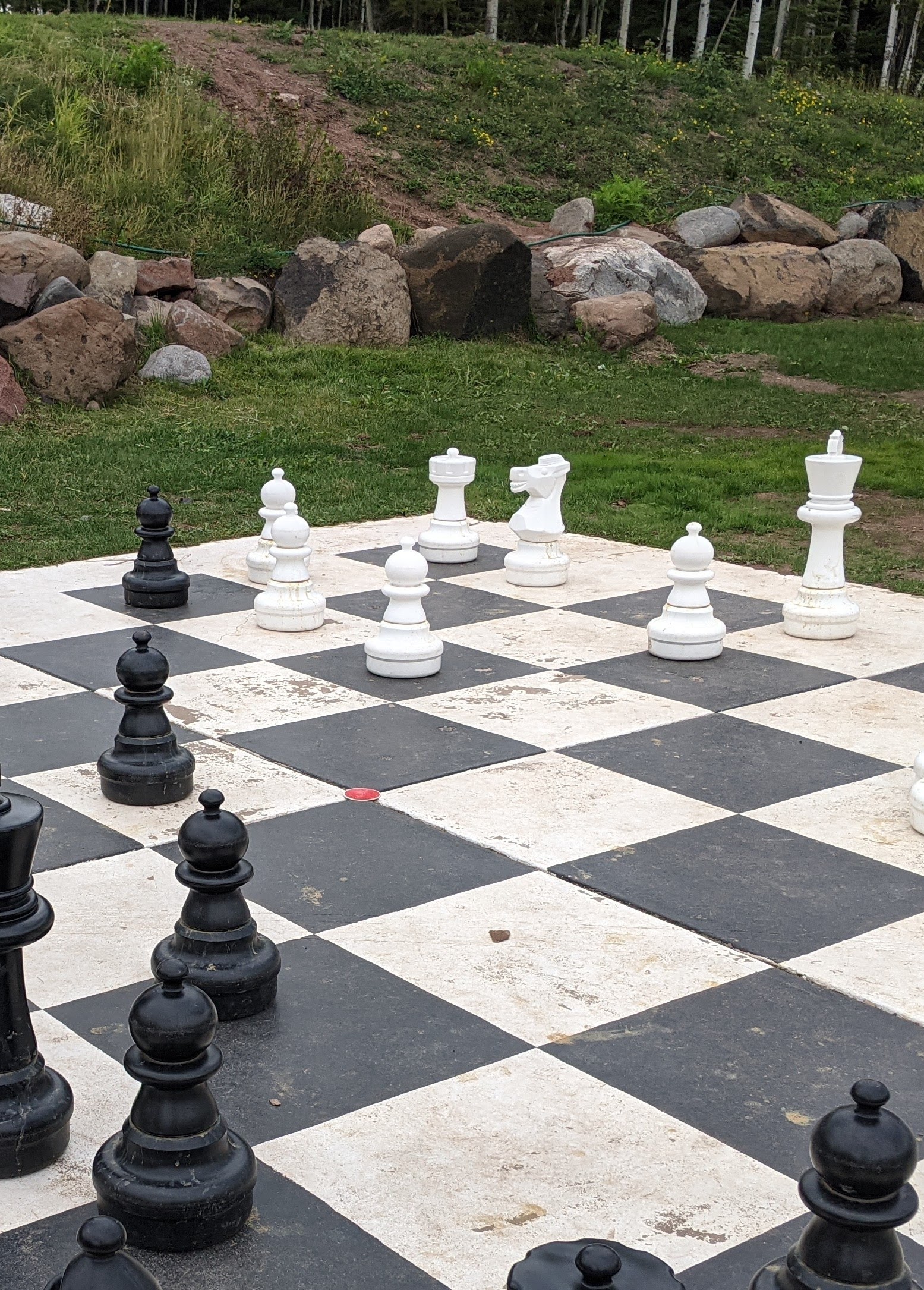
However, due to timing and unexpected events, the gameplay never happened. It’s the reality of DUO itself. The main objective of the game is for each player to navigate their king and queen to the board’s four innermost squares, the squares accentuated by a center circle drawn or placed onto them—such as with a coaster or a coin—to represent the game’s cooperative focus. But the meeting in the middle doesn’t always happen, despite each player’s best intentions, efforts, and spirit of camaraderie. And that’s the real nature of striving for cooperation while living in a competitive world.
It’s the reason why DUO isn’t a political statement. It’s always been kept at the interpersonal level, one-on-one. It’s a medium by which two people can discuss, among other things, questions such as: What does it mean to truly cooperate with life? Why is the world the way it is right now? And what does that mean for life going forward? Understandably, though, that’s not everyone’s idea of a good time. And for such players the alternatives are plenty. Competitive chess sets have been spotted at Snively’s Lounge and Wussow’s Concert Cafe in Duluth, in addition to a giant chess set outside Caribou Highland’s Lodge in Lutsen. And at Duluth’s Bent Paddle Brewing, Duluth Tap Exchange, and several other places along the shore, including Thunder Bay’s Sleeping Giant Brewery Company, a healthy selection of tabletop games await.
For Hale, the choice depends on the people, time, and place. If he’s at a coffee shop in the morning with his wife, for example, he likes something Scrabble-y. If he’s at a brewery with friends, he likes what he calls “The Question Game,” a boardless game in which each person takes their turn answering a provocative, deep, or silly question, the answers to which no doubt occasionally mix with bursts of laughter under the ebullient influence of beer.
There’s “a time to weep and a time to laugh,” says the ancient Solomonian wisdom. “A time to wail and a time to dance for joy.”
A time to DUO, and a time not to DUO.