
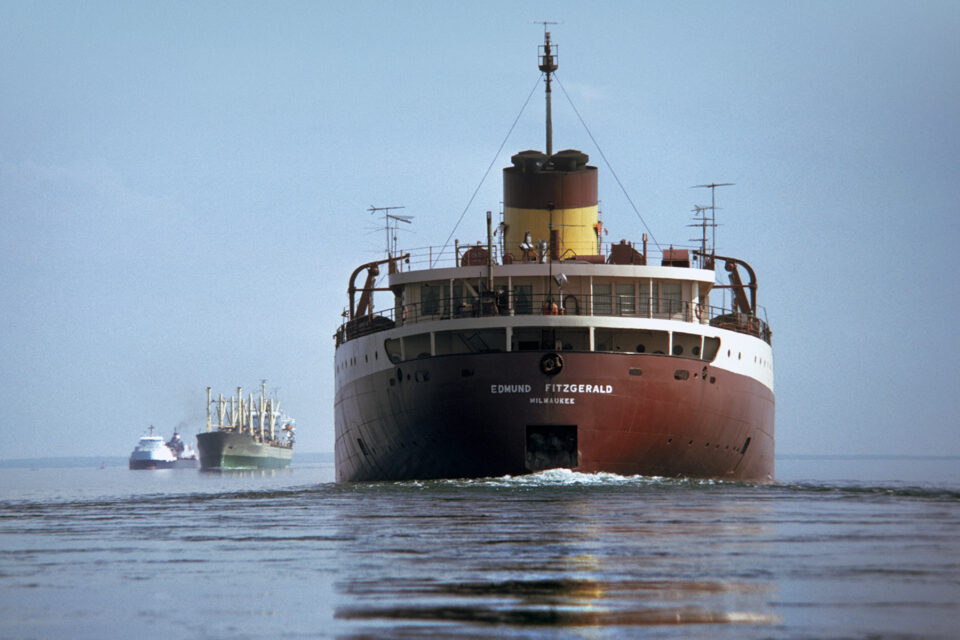
On Nov. 9, 1975, the SS Edmund Fitzgerald departed from Burlington Northern Railroad Dock No. 1 in Superior, Wisc., for the last time.
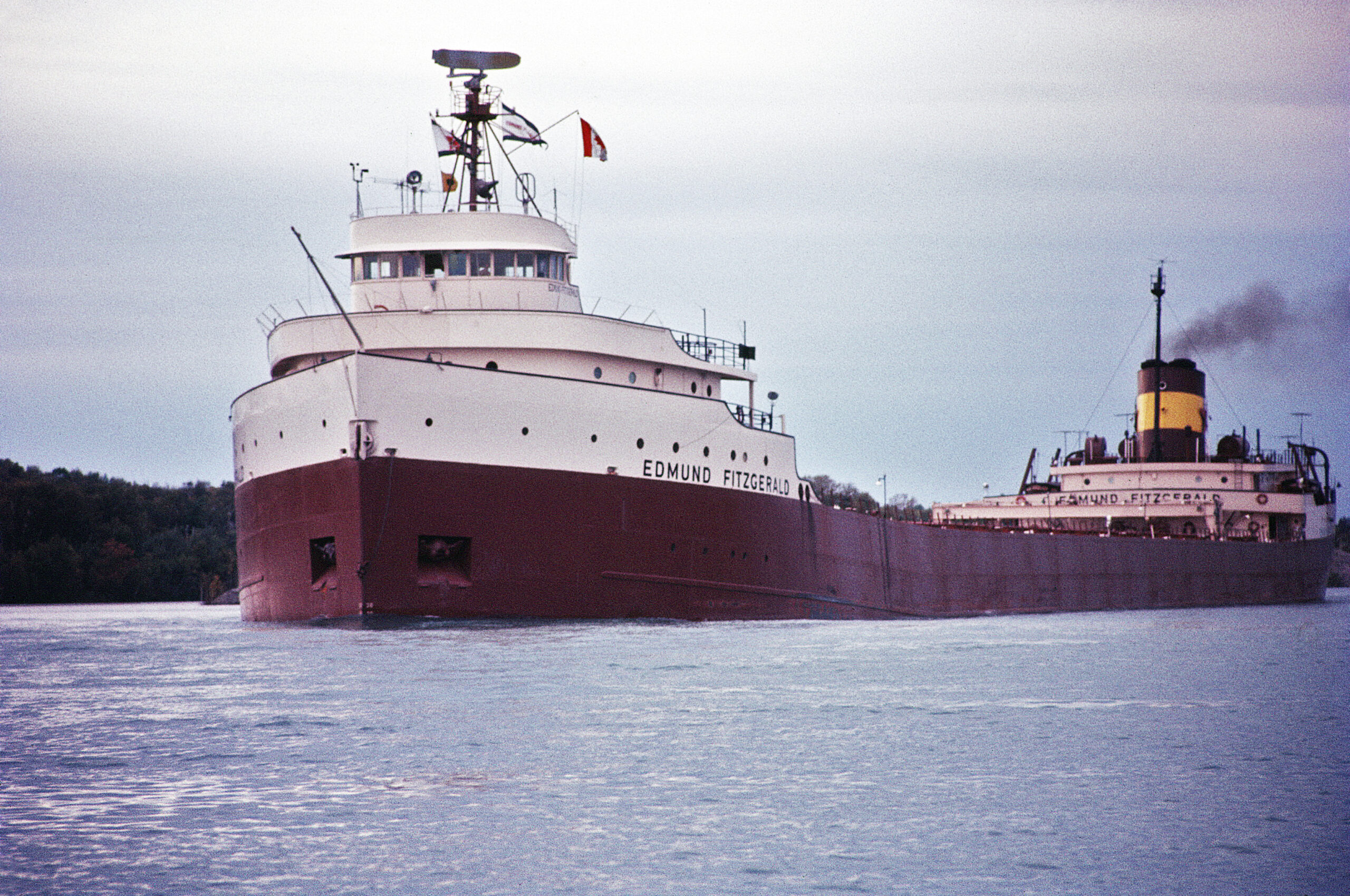
Captain Ernest M. McSorley and his crew knew a storm was brewing, but with one of the largest freighters on the Great Lakes (the largest when she was launched in 1958 at 729 feet), they weren’t too concerned. The Edmund Fitzgerald had seen storms before, and with improvements in technology, there hadn’t been a wreck on Lake Superior in over 20 years.
On the evening of the 9th, just as the storm was advancing, the Fitzgerald met the SS Arthur M. Anderson (captained by Jesse B. Cooper) near Two Harbors, and they began traveling together about 10 miles apart. As the storm intensified the next morning, the captains agreed to hug the Ontario shoreline to avoid what was supposed to be the worst of the weather.
The gales of November proved unpredictable, however, and by mid-afternoon the Edmund Fitzgerald was in trouble. Pummeled by record high Nor’easter winds, snow, and immense 30-foot waves, the ship began taking on water as it struggled toward Whitefish Bay. An hour later, their radar failed. At 7:10 p.m., Captain Cooper of the Anderson contacted Captain McSorley for an update. “We are holding our own,” McSorley replied, and the radio went silent.
Honor and Remembrance
Fifty years have passed since the Edmund Fitzgerald and her crew of 29 vanished beneath the icy waters of Lake Superior, and the haunting legacy of the ship’s final voyage still resonates deeply across the Great Lakes region.
“The story of the Edmund Fitzgerald endures for several reasons,” states Hayes Scriven, site manager of Split Rock Lighthouse. “Of course, Gordon Lightfoot’s song ‘The Wreck of the Edmund Fitzgerald’ has kept the tragedy alive in the public consciousness, but that’s only part of it.”
“There are still unanswered questions about why the ship sank, and that mystery has fueled decades of discussion and investigation,” he continues. “It’s also a deeply human story—about loss, courage, and respect for the power of nature. These modern freighters seem almost invincible, yet the Fitzgerald reminds us that even the strongest vessels and most skilled sailors remain at the mercy of Lake Superior.”
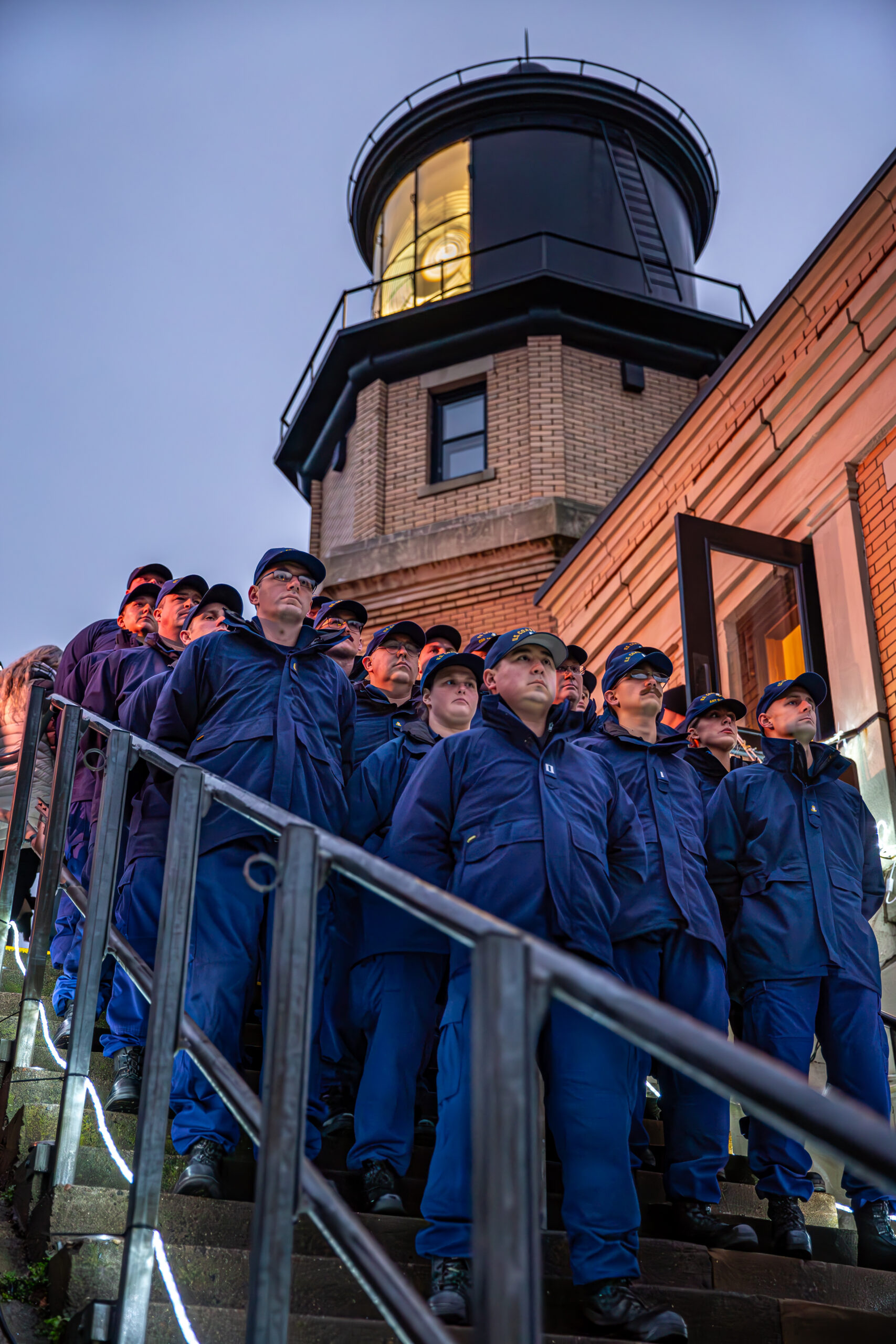
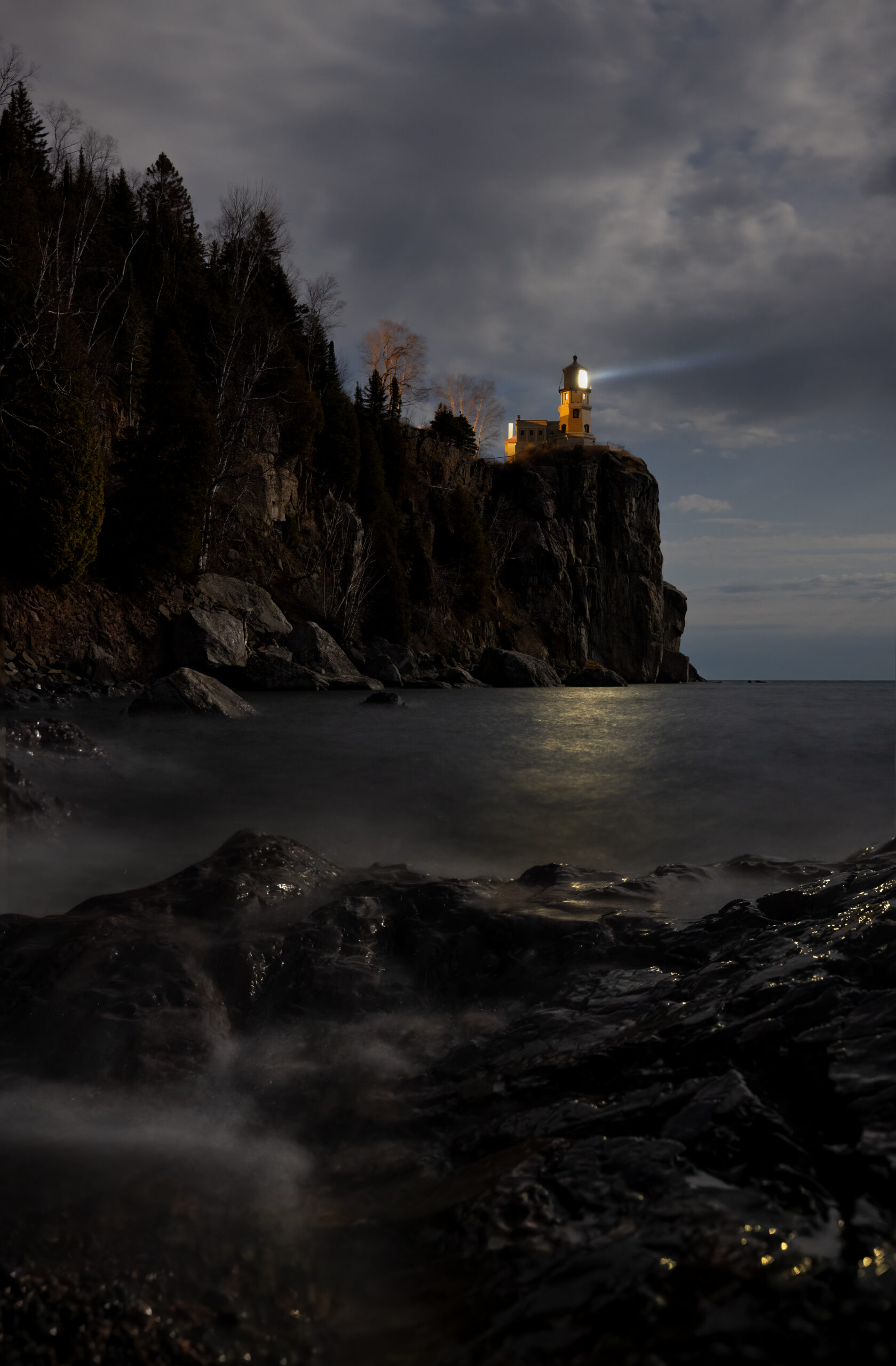
Split Rock Lighthouse will once again hold its yearly beacon lighting ceremony this month, commemorating 50 years since the wreck. The tradition draws mariners, families, and history buffs to remember the loss and reflect on what it meant, and still means, to work the ore ships that make industry possible.
“On Nov. 10, we honor the crew of the Edmund Fitzgerald and all sailors lost on Lake Superior,” Scriven says. “Throughout the day, we offer special guided tours that trace the final voyage of the Fitzgerald and feature a documentary about the ship.
“At 4 p.m., we close the observation deck for the memorial program,” he continues. “This year, former Site Manager Lee Radzak—who began this tradition 40 years ago—will speak about its origins. The Lighthouse Quartet will perform the Navy Hymn, followed by the Muster of the Last Watch.”
The Muster is a maritime tradition honoring those lost at sea, where the ship’s bell is rung during the fallen sailor’s watch. Their name is called, and the bell tolls in place of their usual reply, “aye-aye.”
“When an entire vessel and its crew are lost, as with the Edmund Fitzgerald, the ceremony is performed ashore as the Muster of the Last Watch,” Scriven explains. “Each of the 29 crew members is honored by name.”
Though Split Rock Lighthouse was no longer in operation the year the Fitzgerald sank, it served as an important navigational aid for almost 60 years. It remains an iconic historical feature of the Great Lakes, and a noble gathering place to pay homage.
Crew Life on a Great Lakes Ore Freighter
Working on an iron ore ship is a unique experience. LeRoy Johnson of Grand Marais fondly remembers his time as a deckhand aboard the J.H. Hillman, Jr. during the summer of 1966.
“I was young and it looked like it would be an interesting job, so I applied for it,” he says. “Back in those days, you could get in pretty easy, and a lot of people didn’t stay on very long. They’d take one or two trips down through the Great Lakes and they’d quit, so there was usually an opening.”
As a deckhand, Johnson’s primary responsibility was to maintain the ship while traveling. The J.H. Hillman, Jr. was an older freighter, and there was always painting and scrubbing to do. When stopped at shore, Johnson and his friend and fellow deckhand Clifford Berglund were lowered to the dock, and they would move the large cables from the ship and attach them to different spiles as cargo was loaded and unloaded.
It took about a week for the ship to make its way through the Great Lakes and back. Sometimes ore ships would meet each other along their routes. Johnson remembers when he saw the Edmund Fitzgerald.
“I was down between Detroit and Windsor, Canada, between Lake Erie and Lake Huron. It’s like a river, some places it was a bit wider. You’d meet a boat and then they’d honk at you—blow their horn as we’d go by. I’d see the people, you could wave to them,” he recalls. “It was a pretty fancy ship, the Edmund Fitzgerald. Only a few years old. We met them more than once.”
Sleeping arrangements on the ship were basic bunks, with three men to a room. The food, however, was fantastic. “They fed you like kings,” Johnson says. “You’d eat as much as you want. Stews and soups and steak and pork chops—a full kitchen on there.”
Johnson left the J.H. Hillman, Jr. at the end of the summer, and while he didn’t experience the gales of November, he did encounter occasional stormy weather that caused the 620-foot-long freighter to twist in unnerving ways.
“When you’d stand on top of the pilothouse and look down the ship, you could see the bend in the middle a little bit—it’d flex,” he recalls, “and they’re built that way, you know, to a point.”
While aspects of life on an ore ship can be difficult and dangerous at times, Johnson recommends the job for young people and anyone who doesn’t mind being away from it all. “It’s a good experience to see what our little part of the world is like on the Great Lakes,” he says. “I think it’s a good deal.”
Tragedy to Technology
Shipping on the Great Lakes has become significantly safer in recent years thanks to advances in technology, and there have been no major wrecks since the Edmund Fitzgerald.
“In fact, several key improvements were made directly because of that tragedy,” Scriven says. “The U.S. Coast Guard mandated pre-November inspections of hatch and vent closures, as well as lifesaving equipment.”
Upgrades were made to navigational charts for Lake Superior, vessels were required to have Emergency Position Indicating Radio Beacons (EPIRBs) on board, and marine forecasts became more accurate with new systems.
Modern freighters now rely on real-time weather data, GPS tracking, and automated navigation systems to avoid hazards that once claimed hundreds of vessels.
The Legend Lives On
Though the SS Edmund Fitzgerald disappeared beneath the waves half a century ago, her story continues to echo across the Great Lakes. It reminds us of nature’s power, and gives us pause to appreciate the brave people who work the water.
If you’re planning to attend the memorial beacon lighting ceremony at Split Rock Lighthouse on Nov. 10, Scriven recommends purchasing tickets in advance online (mnhs.org/splitrock), and take advantage of their new free parking shuttles from Silver Bay. Arrive early “to ensure parking and to take full advantage of the day’s activities,” he says. If you can’t make it to the event in person, a livestream of the ceremony will be available on both the Minnesota Historical Society’s YouTube channel, and Split Rock Lighthouse’s Facebook page.
“I’m honored to be part of a site that helps keep this history alive,” Scriven says. “Split Rock Lighthouse stands as both a memorial and a reminder of the enduring relationship between people and Lake Superior.”
Taking place just days before the beacon lighting, the Gales of November is a separate educational, fundraising, and networking event held in Duluth by the Lake Superior Marine Museum Association. Friday’s gathering at the Garden Wedding & Event Center features several speakers and a buffet luncheon. Saturday’s event takes place at the Duluth Entertainment Convention Center, and features more speakers (including Hayes Scriven), an Italian buffet luncheon with a cash bar, and a silent auction. Tickets can be purchased at the Lake Superior Marine Museum Association website: lsmma.com.
Want to dive even deeper? “Edmund Fitzgerald: 50 Years Below” is a five-episode podcast produced by the Duluth News Tribune that explores the history of this iconic ship from launch to legacy, including the mystery around her demise. You’ll hear stories from a former coast guardsman who aided in the search for the missing freighter, a news anchor who broke the story, a diver who has seen the wreck firsthand, and many more. Episodes drop weekly until Nov. 10 (bit.ly/dntfitzgeraldpodcast).
As bells toll each year in remembrance, the legend of the Edmund Fitzgerald lives on.