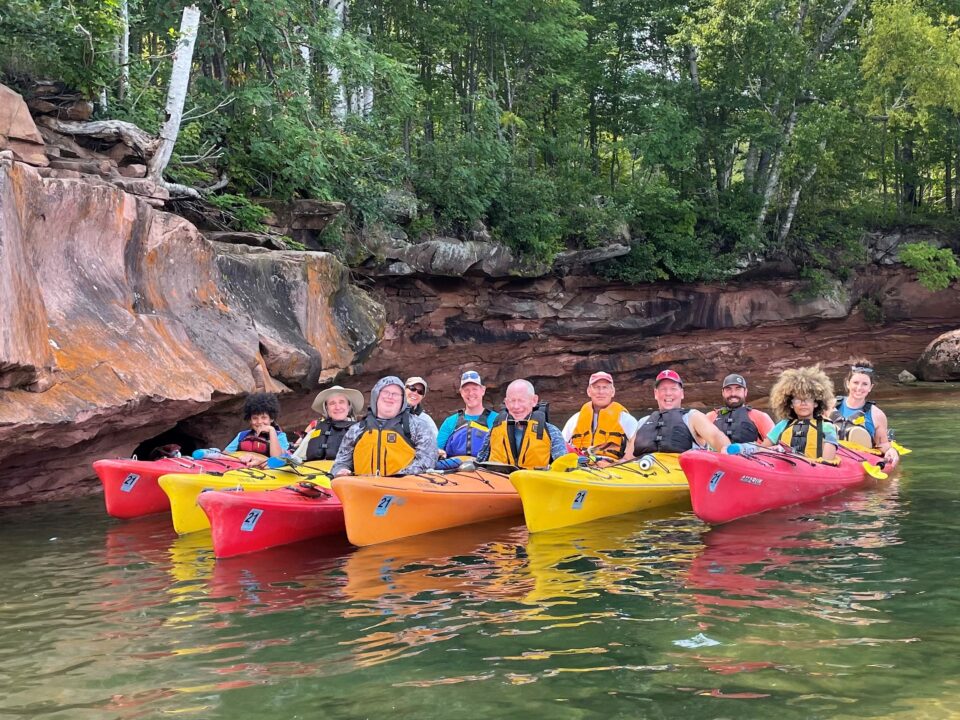
Outdoor recreation is a major component of the Northern Wilds lifestyle. Many people choose to live here because of the incredible opportunities to experience nature by ski, bike, kayak, and other means. But how are these opportunities accessed by people with disabilities in our region? How do they access nature on their own?
Enter Northland Adaptive Recreation, an organization that offers adaptive sports and recreation programs that promote an active lifestyle and independence for people with disabilities.
Northland Adaptive Recreation (NAR) has an office in Duluth’s Central Hillside but serves a huge area across two states. “We go south to Hinckley, north to the Canadian border, west to Bemidji, and east over to the Chequamegon Bay area of northwest Wisconsin for our programming,” says Mark Hanna, programs manager at NAR. The organization conducts programming at places like Giants Ridge ski area on the Iron Range, the Apostle Islands of Lake Superior, and the mountain bike trails of Duluth, among others. For Hanna, “We remove barriers, whether they’re real barriers or perceived barriers, toward recreation for people of all abilities.”
One of NAR’s main objectives is to connect people with the adaptive equipment and instruction they need to thrive. “A lot of adaptive equipment is very spendy and can only be purchased online. There’s no storefront shop to sample different adaptive equipment,” Hanna explained. “People should try out equipment with us before buying it on their own.”
Participants in the program can test equipment from a variety of manufacturers, get properly fitted, and receive instruction. “If they find something they love, they can purchase exactly what works best for them,” says Hanna.
NAR operates as an LLC under the Miller-Dwan Foundation. By working under that umbrella, NAR can deliver outstanding adaptive recreational sports programming directly to the communities it serves.
Adaptive Sailing: Partnering with the DSSA
The Duluth-Superior Sailing Association (DSSA) is one of NAR’s many community partners. The two organizations have partnered for over three decades, and the collaboration continues to thrive.
The DSSA provides sailing expertise through certified instructors and a fleet of sailboats. NAR brings experience working with people with disabilities, and can train volunteers and DSSA staff on accessibility practices. NAR also brings its own equipment, like a Hoyer lift—a hydraulic medical device that safely transfers sailors with limited mobility from the DSSA pier into a sailboat.

NAR’s connection with the DSSA was formed by Scott Anderson, a local adaptive sports hero. Anderson was accidentally shot by a friend in 1975 at age 15. The bullet hit Anderson’s spine, and paralyzed him from the chest down.
It was an accident, and Anderson’s attitude was that he wouldn’t feel sorry for himself: “Let’s find out what I can do, and take advantage of opportunities when they come along,” said Anderson.
Anderson had never been on a sailboat until after he got hurt, yet sailing became his passion. Anderson loved controlling the sails, and the tiller: “It’s just you and the wind and the water, and that’s it. Everything goes away,” said Anderson. “It’s just a peaceful experience.”
Anderson went on to be president of the DSSA in the 1990s and helped to further develop adaptive sailing for people with disabilities. It was Anderson’s desire that the DSSA establish a fund in his name to support adaptive sailing infrastructure, as well as participation by disabled and disadvantaged sailors of all ages. The fund is named the Scott R. Anderson “Sailing for All” Memorial Fund.
NAR conducts adaptive sailing lessons with the DSSA on Tuesdays from 5:30-8 p.m., June 8 through July 21. Registration for the 2026 season is now open.
Growing Up with NAR
One of NAR’s current participants is May Hall of Duluth Township. Hall has participated in NAR programs for over a decade and recently turned 21. She will graduate from Minnesota Independence College and Community this spring, and plans to continue living and working in the Twin Cities, while staying connected with MICC through their community program.
Hall, who has a prosthetic leg, has done a variety of NAR programs, ranging from recumbent biking to snowboarding to kayaking. She first learned to ride a recumbent bike through NAR and loved it so much that she purchased one of her own.
Hall has also done NAR’s sea kayaking program, which culminated with a trip on Lake Superior. “We toured the Apostle Islands. My parents got to come as well. It was really fun kayaking on the waves and seeing the sea caves,” recounts Hall.

“I’m an experienced snowboarder, too,” she added. “I’ve been snowboarding with NAR since 2019. I learned through lessons with NAR at Spirit Mountain in Duluth, and next winter I’ll be joining the Special Olympics as a snowboarder.”
Small Staff, Big Partnerships
Northland Adaptive Recreation has three full-time employees. Along with program manager Hanna, Emma Bursinger and Alec Kadlec are program coordinators. But this small number does not represent the true number of people who help in NAR programming.
“Every program we do is a partnership, from climbing at the College of St. Scholastica, to sailing, to even our ski program,” Hanna said. “We utilize the expertise that our partners have.” Another example is NAR’s partnership with the YMCA in Hermantown for youth adaptive swim lessons.
Perhaps the most important partners are NAR’s volunteers.
“We have 100 volunteers just in our ski program alone,” Hanna said. “Both Spirit Mountain and Giants Ridge are local government entities that serve the whole community, and we fulfill a niche for them by providing adaptable ski and snowboard lessons and equipment. They, in turn, provide discounted lift passes for our volunteers and participants, and free storage for our equipment. There’s no way we could run our adaptive ski program without the support from these partnerships.”
NAR’s three core staff members are routinely doing fittings, consulting participants on finding specific equipment, and conducting programming. “We juggle 14 different program activities spread throughout the year,” explains Kadlec. These include such various sports as archery, rowing, golf, youth swimming, and climbing. “Then there are the administrative aspects behind our programming as well. The day of programming is a quarter or a third of our weekly responsibilities. Registration and participant intake, developing our programs, and equipment maintenance are all part of our daily work,” explains Kadlec, who also does all the mechanic work on NAR’s bike fleet.
Reaching Out to the Community
So how does NAR find participants? “You’d be shocked by the amount of people in the geographic areas we serve who don’t know who we are,” says Bursinger.

“We regularly get calls from people who say, ‘I just found out about your organization,’” Kadlec added. “That said, a lot of the people that we serve come to us through referrals from physical therapists, occupational therapists, and other people in the clinical setting. We also get people who are friends of participants, and people who are in community groups with other NAR participants.”
NAR serves about 140 unique participants annually, with some participating in multiple programs. Then there are one-day events that NAR holds in addition to its regular programming, such as their dog-sledding event, sea cave kayaking, curling, and others. About an additional 100 participants attend these day trips, which allow folks to experience a new sport or outdoor pursuit.
NAR serves a wide variety of individuals, including people with physical disabilities and cognitive, developmental, or sensory challenges. Local schools also partner with NAR to provide accommodations for outdoor field trips.
Helping Everyone, Making Paralympians
NAR’s youngest participant is 4 years old, and its oldest is 93. About one-third were born with a disability, while the rest acquired one later in life.
“They get a curveball thrown at them physically, or they get a diagnosis that puts them in a spot to need adaptive equipment and support,” Hanna said. “In the end, the activities we offer are a medium for personal growth. That’s the amazing outcome of our programming—getting out of the social isolation, which is very real for people with disabilities. Learning to be independent and involved in a community setting, and being connected to their community. Being able to define themselves by what they do rather than by their diagnosis… All those things that you can’t really see are so important to our participants.”
NAR is also proud of developing their first Paralympian. Duluth native Blake Eaton competed in three events at this year’s Winter Paralympics in Milan, Italy, and has been doing adaptive recreation with NAR since age 4.
There are many ways to support NAR’s mission. Community members can volunteer, spread awareness, or contribute financially. The organization provides more than $20,000 in scholarships annually and relies on community support. Learn more at: northlandadaptive.org.