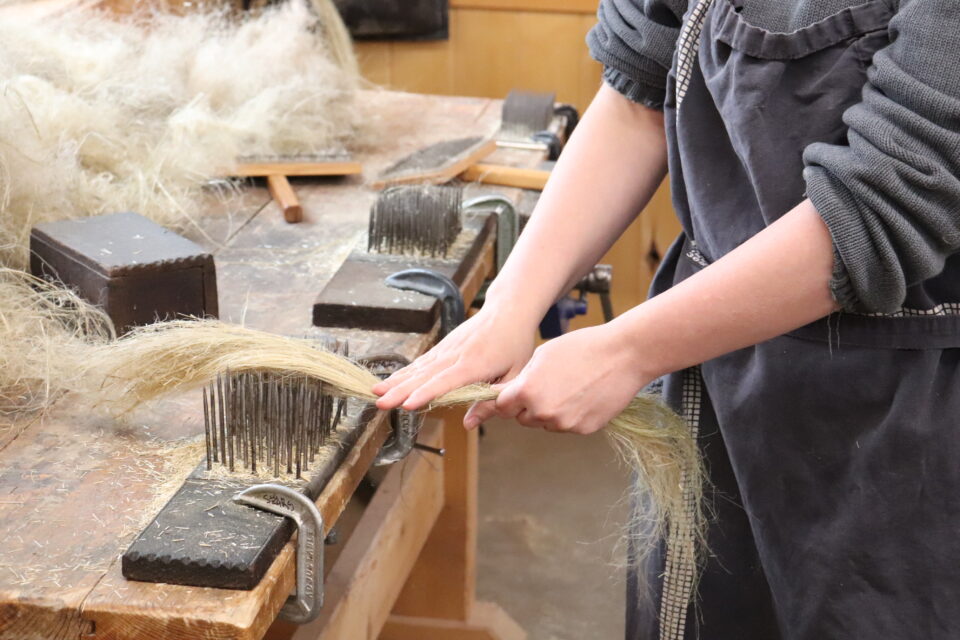
As a weaver, you make choices about which materials to use. This is usually determined by what you are trying to make. Soft, thick towels need a lofty cotton; hardwearing rugs might use heavy linen; warm blankets will take a next-to-skin soft wool. Often, my project centers around the material, as I am curious to find out what different fibers are like. Years ago, when I made baskets, this meant different kinds of bark: birch, cedar, ash, willow, and so on. In my current practice, it means I weave cotton, cotton-linen blends, hemp, wool, and linen. All are natural fibers, meaning they will biodegrade, and some even improve soil—like wool, which assists in carbon sequestration.
Quite often, ordering thread and yarn to weave with means it comes from far away—cotton from Canada, linen from France, wool from just about anywhere. Tracing the source of the material can be somewhat difficult, as consumers don’t generally demand that level of transparency. As I continue exploring, I am trending toward more local, sustainable, and ethical material choices.
About five years ago, my search led me to Fibershed, an organization that promotes building fiber economies by connecting shepherds, farmers, mills, dyers, and makers. In 2023, I knit a sweater through funding provided by the local affiliate, Three Rivers Fibershed. The wool for the sweater was sourced regionally, combining wool from five different sheep breeds to demonstrate the array of natural colors. I then washed, combed, spun, plied, and knit a colorwork sweater based on the pattern Sea Glass by Wool & Pine.
Enlivened by this experience, I began to pursue the possibility of bringing local yarn into my weaving practice. A recent commission I am working on involves weaving fabric for two tote bags using wool from Patti Dougherty of Holly Ridge Farm in Ellsworth, Wisc. She hopes that having woven items available to see and touch at wool festivals will encourage people to use local wool, particularly from breeds like her Leicester Longwool sheep, which is on the Livestock Conservancy’s threatened list. I hope the experience of this project will lead to further work with the region’s many locally available but underappreciated fiber sources—perhaps using bison down yarn from a farm just outside Duluth, alpaca from the local Grumpelstiltskin mill, or the many shepherds raising Shetland, Icelandic, and Corriedale sheep.
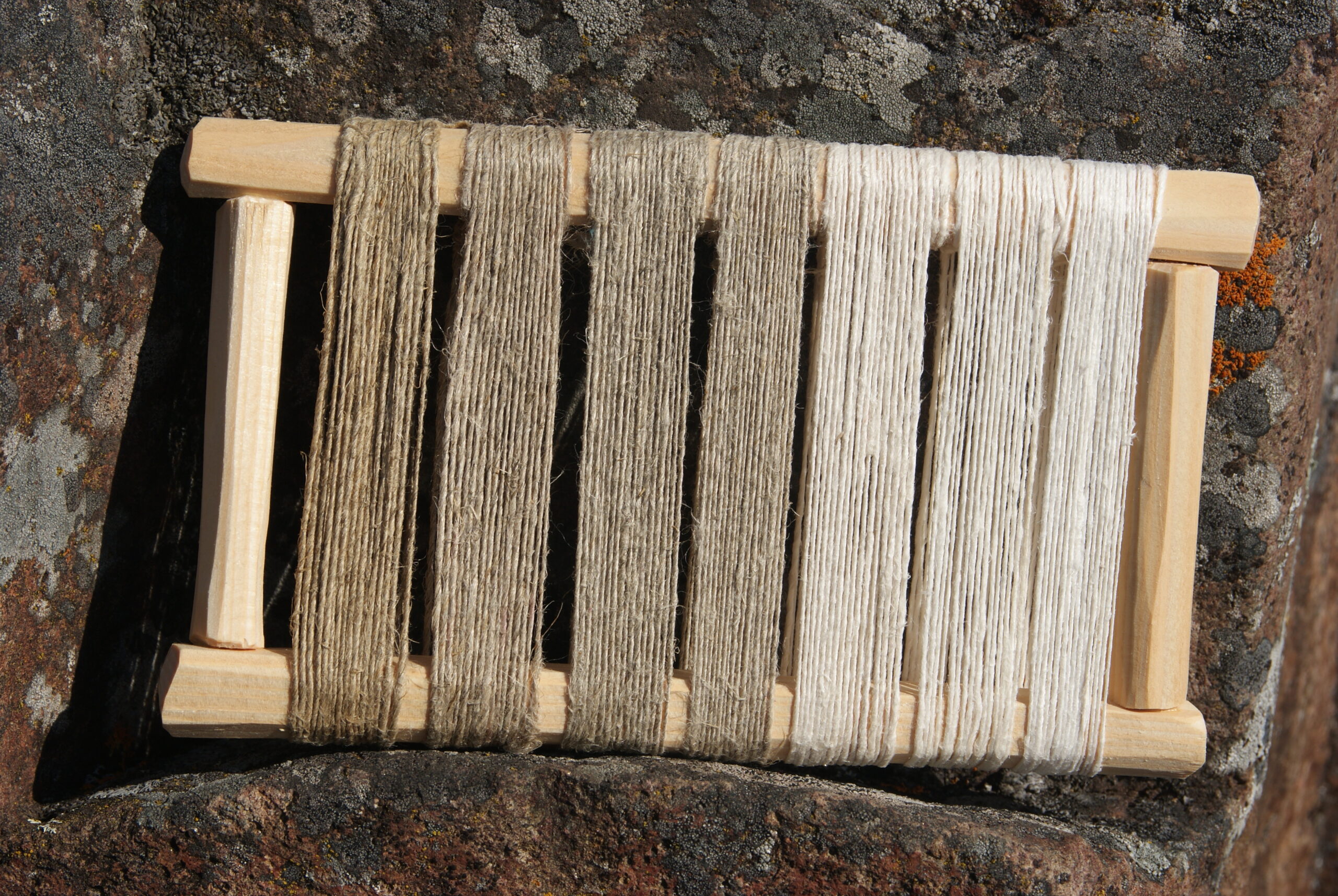
Another project I will be participating in promotes the use of linen: a strong, durable material that is moisture-wicking, temperature-regulating, breathable, and pleasant to touch. Linen had an abbreviated history in the United States, being overtaken by the cotton industry, and only recent efforts have begun to revive it. Flax, the plant from which linen is derived, is a very sustainable crop, using little water and no irrigation, growing quickly without pesticides or genetic modification, and producing no waste, with byproducts used for everything from insulation to tennis racket composites.
The project is called “Living Lineage: Linen in Scandinavian Folk Art and Modern Innovation,” a joint venture between the Three Rivers Fibershed and Weavers Guild of Minnesota, funded by a grant from the American-Scandinavian Foundation. The project will use both locally grown and nationally sourced flax. Flax “strick”—the semi-processed stage between plant and yarn—will be spun by members at the Weavers Guild in Minneapolis. With the resulting yarn, I will weave fabric, using it to sew an Överdel, a traditional Swedish woman’s shirt. The shirt, as well as other pieces made by participating artists, will be on display in December at Open Book, an art center in the Twin Cities.
As awareness of the benefits of materials like wool and linen grows, I hope these budding industries will flourish. I look forward to using them in my own weaving and sharing the joy of these wonderful local materials in my spinning and weaving classes.
Josie Cooke is a fiber artist in the Artisan Development Program at North House Folk School, where traditional craft is taught on the shore of Lake Superior.