“What do the dogs do in the summer?” Friends ask us this frequently, and until this year, our reply has been, “rest.” This year, most of our dogs were able to do something a little different, thanks to our friend and handler Kendra, who worked for Alaska Icefield Expeditions last summer and spoke highly of the company and her experience there. At the end of April, Matt, Josh, and Kendra loaded 24 of our dogs and drove five days to Juneau, where the dogs helicoptered up to the Herbert Glacier for four months of glacier tours, mainly for cruise ship guests.
The benefits of this arrangement are many: the dogs get exercise all summer, plus loads of attention from tourists, and the company staff. A few received special privileges in the musher tent—Tom and Bruce had spots on the bed (well, until Tom lost that privilege by soiling it). There are almost zero bugs on the glacier and much cooler temperatures than a Minnesota summer affords. We had a break from dog chores for the summer, plus the company paid for our gas money to drive the dogs up there and home, as well as the dog food, and a little bonus money. As long as we didn’t have any major breakdowns, this seemed like a win.
Long story short: 24 dogs made it to the Herbert Glacier and ran many tours consisting of a short, flat loop on snow. The camp on the glacier is a temporary one where the musher housing and dog housing are set up for four months and then removed. Even the dog poop is hauled off the glacier. Helicopters are a mainstay of the business, hauling dogs, people, or supplies up or down on a daily basis.
At the end of the summer, it was my turn to do the big drive and bring the dogs home. The dog truck had remained in Juneau for the summer, so my friend Danielle and I flew up on Sunday morning and connected with the truck and trailer right away. We would be bringing home 33 dogs, considerably more than had come north, and needed to make a few mechanical repairs, as well. We had some work to do before the next day, when the dogs flew down from the glacier. We headed to Home Depot. It wasn’t long before we had enough snacks for the road, and hardware and parts for necessary trailer upgrades, so we hiked around the Mendenhall Visitor Center, and checked out downtown Juneau (full of cruise ships) before bed. The next morning, we were told, we should be ready to caravan with the other dog trucks to the airport at 7 a.m.
There aren’t many federal airports where you can find dog trucks lined up on the tarmac. We were each given a neon safety vest and ear protection, and for the next several hours the helicopters just kept coming and going, each one depositing a load of dogs, a musher, and some gear. Six of us would run up to the chopper at the pilot’s OK signal. One person opened the hatch, and one by one, a special wood dog kennel was opened, a dog carefully fingered under the collar, the door opened more, and the dog was unloaded to the ground. In most cases, this was pretty seamless. In a few instances, a rather big or terrified dog took a human to the ground, but we were under strict instruction to “not let go,” no matter what. A loose dog at a commercial airport is a very bad thing.
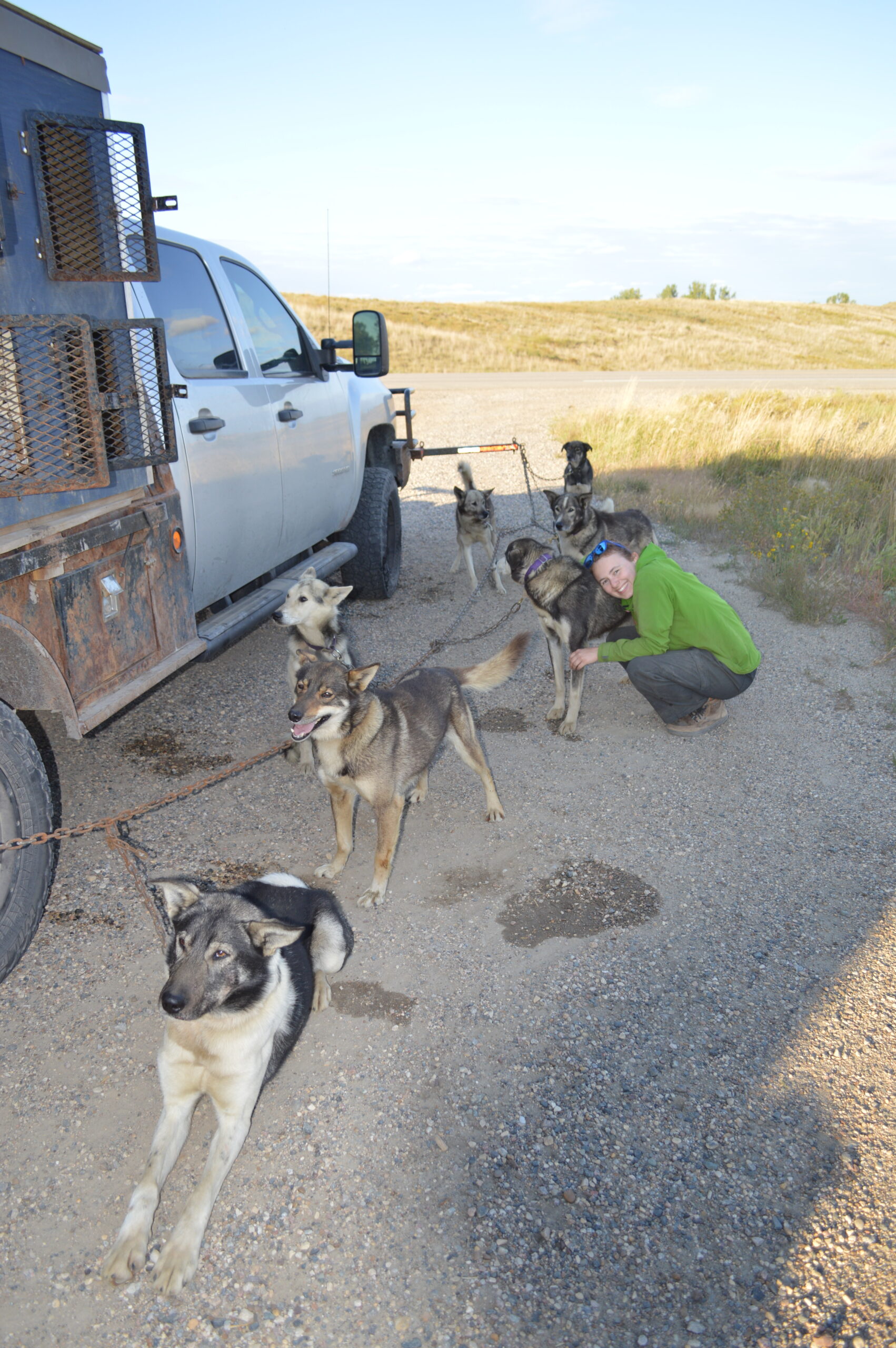
We helped at least 100 dogs unload before mine came down, but what a delight to see familiar dog faces after these months away: Itsy, Bruce, Tom, Oreo. A few had gotten so much sun that their hair was bleached blonde. But we quickly reacquainted ourselves.
That afternoon, Kendra, Danielle, and I spent our time reinstalling a trailer wiring plug-in after visiting three different auto parts stores to try and find the right parts. Finally, finding not the perfect thing, we simply figured it out, watched some YouTube, and practiced our electrician skills. With working trailer lights, we were ready to hit the road home.
First, though, it was a four-hour ferry ride. Juneau is actually water-locked. We ferried with all the other dog trucks and dogs to Haines. First, the ferry workers made me practice my backing-up skills. I had to pull all the way to the front of the ferry and then, for no reason that I could understand, I had to back up to the very back of the ferry, with one guy giving me directions on which way to turn the wheel, and I’m fairly certain we had a different understanding of right and left.
After that stressful endeavor was over, we moved to the passenger deck for hours of mountain viewing. I listened to a conversation between two wildlife photographers traveling to Haines to photograph grizzlies that hang out on the river estuaries there, and wished I could spend more time in this part of the world.
We started our drive that afternoon, the colors of autumn already finding their way to this part of the world in early September. Every four to six hours, we stopped and unloaded all 33 dogs for a bathroom, and water, or food break. Sometime between midnight and 2 a.m., we’d pull off on the side of the road and, after unloading the dogs one last time, we’d crawl into sleeping bags ourselves for a few hours of uninterrupted sleep. Itsy, our cab canine companion, would join us in the human compartment of the trailer each night.
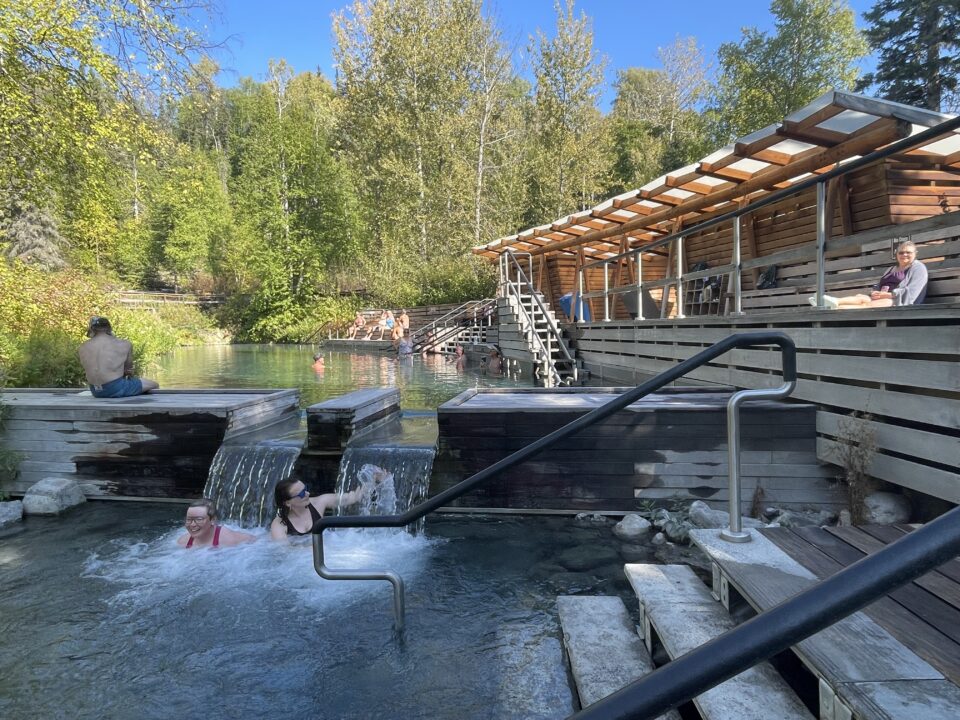
The second day on the road, traveling through the Yukon and British Columbia, I found the beauty to be more than anything Matt had ever described—and he has done the trip several times. Each river drew me in, like something I wanted to throw my canoe onto and follow. The mountains were taller than I imagined, the colors more vivid. We saw a herd of elk, two caribou, a moose, a herd of bison, two bighorn sheep, and 10 black bears. The stop at Liard Hot Springs was a highlight, even in the heat of the day. I discovered that this summer traveling with sled dogs is a very dirty endeavor. In winter, we can don our winter clothes to drop dogs, but in summer, we each became encrusted in layers of dust and grime. I had no more clean clothes, and even hand washing was hard to come by. At least leaving the hot springs, we were clean for a few hours.
The last two days of the trip through Alberta and Saskatchewan were not quite as scenic. We had two run-ins with police. In Edmonton, two police interrupted my dinner to check out my truck license and registration, simply because they had never seen 16 dogs in a truck before. Everything “checked out,” they said. I didn’t tell them about the other 16 dogs in the trailer. Later that evening, we were pulled over for no apparent reason by another officer, claiming we had failed to pull over in the last town. None of us had seen anyone trying to pull us over. He ended up letting us go. Things get a little weird late at night in Canada on the road.
We were happy to get home. Even though September started off unseasonably cold, we weren’t quite ready to run when it was cool, and since then, it’s been too warm. Hopefully, things cool down soon, and we can get these dogs running again. We have a few new dogs in the kennel that joined us from Alaska, and we are looking forward to the season ahead.