


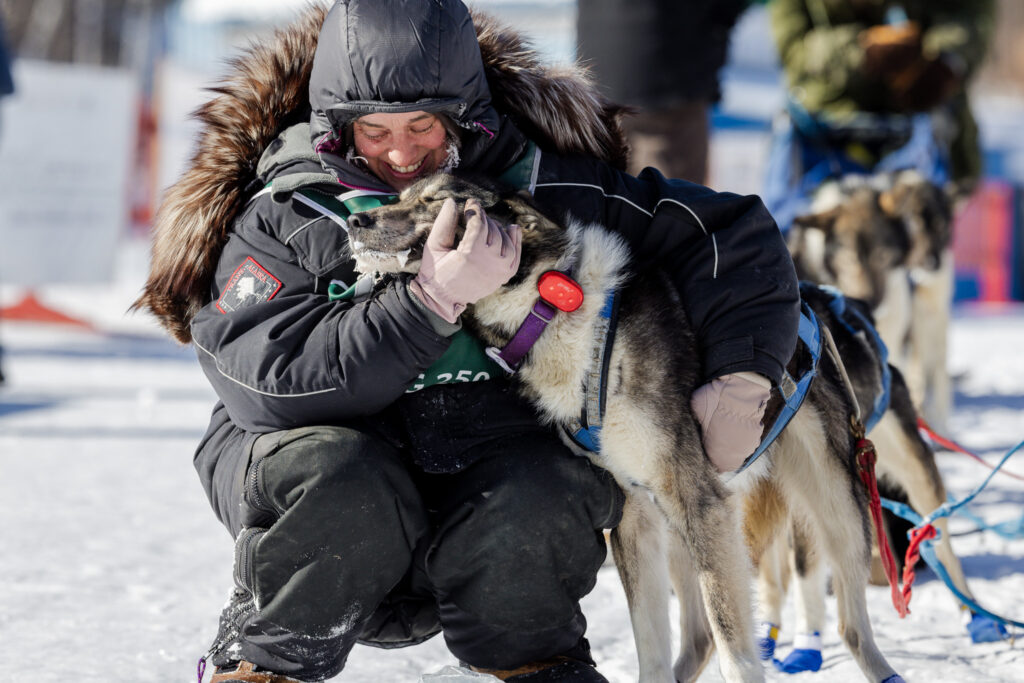
Leg One: The Race Start to Portage, 63 Miles, 40 Degrees
Fort Kent, Maine, with a population under 5,000, sits at the confluence of the St. John and Fish rivers. New Brunswick is just across the river to the north, and nearly everyone here is bilingual, speaking English and French. We enjoy the mountainous scenery, the style of race, and the group of mushers who race this event. This year, like last time we were here in 2023, we brought two teams. My husband Matt raced the 100, and I did the 250.
My team and I left Fort Kent with some trepidation. In the musher meeting the night before, the trail boss had told us in a loud, booming, and rather intimidating voice that there was a section where you “turn sharp, turn again, and then turn again,” and “there wasn’t anything they could do about it.” When asked about the mileage of each leg of the race, he stated he didn’t know. There was rumored to be a lot of plowed road, and there wasn’t anything he could do about that either, apparently.
The run started fine. I was number 5 out of the chute. About 15 miles into the leg, Che’s gait changed. When we stare at these dogs running for a couple thousand miles each year, we know how they run. And something was off with Che. He developed what we call a “head bob.” I started to fixate on it as the miles went on because Che was one of my best leaders. I knew I’d be dropping him at the first checkpoint.
I ended up passing the four teams in front of me, and then the team spit out onto a plowed road with a hard right turn, and I flipped over on my left side. The team did not stop right away. They never seem to care what position I’m in on the back of the sled, or if I’m on the sled at all, really. They just keep running. When I managed to stop the team and get upright, my left side was plastered in wet gravel and mud.
Soon we were off the plowed road again, and the trail wound quickly back and forth through the trees. The team loved this—another chance to drag the musher—and they sped up. We veered around a tight turn, and suddenly I was catapulting into a frozen creek. The sled crashed and tipped as I went flying with a guttural scream, which was fortunate because it kept the dogs from running away without me. I managed to get upright, and we were off again. We hit another long stretch of plowed road. This time I wasn’t sure I was on the right trail. Maybe I had missed a turn? I scanned for the reassurance markers and couldn’t see any. Should I go back? Turning a team around on a plowed road—or anywhere, for that matter—is scary. It is another chance to lose the team or have dogs get into a fight.
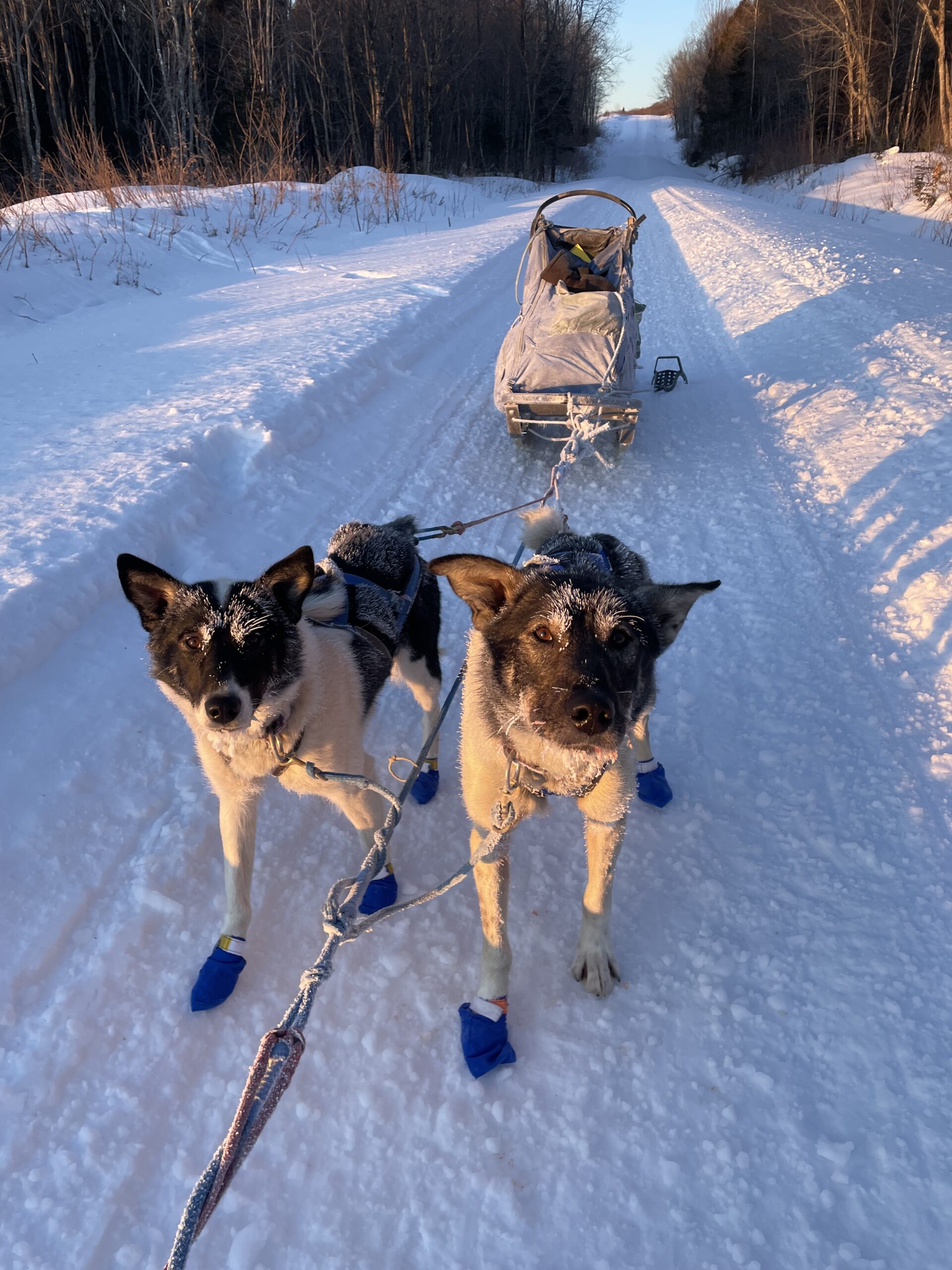
I kept going. Finally there was a trail marker, so I at least knew I was going the right direction.
When we pulled onto Portage Lake, an entourage of snowmobiles was waiting. It is a custom at Can-Am to have a procession of snowmobiles accompany the first team down the lake. It was a spectacle, and not one I necessarily enjoyed. This year, two different drivers kept telling me to get on the hard-packed trail, which was in the middle of the snowmobile procession. But my dogs only wanted to follow the snowmobiles, so I couldn’t get them to follow the dog trail, which had no fresh snowmobile tracks on it. We continued down the punchy trail, finally reaching the checkpoint.
Legs Two and Three: Portage to Rocky Brook, 48 Miles, 20 to 30 Degrees, and then to Sylver, 36 Miles
By the time I left Portage, it was dark. The air temperature continued dropping, settling into the 20s, a much more favorable temperature for everyone. As I neared Rocky Brook, though, the trail spit out onto a plowed road again. The gravel was frozen now, and the road went down a hill to the left and up a hill to the right. It was a wide-open area, though. The dogs had too much room for indecision, and though I yelled “Haw! Haw!” in my deep, rumbly musher voice, the leaders started veering right. “Haw!” I growled again, to no avail. Temper and Oreo dragged everyone right, and by the time I was able to stop them, we were too far right to enable a simple turn. I would have to double the team back on itself, always risky because this allows dogs to bunch up and fight, and I had a few boys who really hated each other. With the hook in the gravel—a precarious situation that wouldn’t hold once the team spun around—I ended up flipping the sled on its side so if I lost my hold, they couldn’t get as far… I hoped.
I turned them successfully without any fights. But now we were facing a sharp right turn, on gravel, on a downhill, with a large snow berm on my right that I would never make it around without flipping. So I decided the safest thing to do would be to keep the sled on its side and hang on.
Immediately I was dragging on my side on gravel at a ridiculous speed, yelling obscenities. At this rate my clothes were never going to make it to the finish. Finally I was able to stop, get the sled upright, and keep going.
Leg Four: Sylver to Allagash, 55 Miles, Single Digits to Below Zero
At Sylver I had about 3.5 hours to rest the team before continuing. I gave them each a very large, raw chicken thigh, which they devoured.
On the way to Allagash, we were moving well and then suddenly Temper was looking around him, and other dogs were too. I knew they smelled something. I spotted two large moose in the woods off to our left. The dogs were really running fast now, and then just ahead I spotted two canine-looking animals. They didn’t appear large enough to be wolves—maybe coyotes? One immediately ran into the woods, and the other continued running ahead of us for a while, then disappeared.
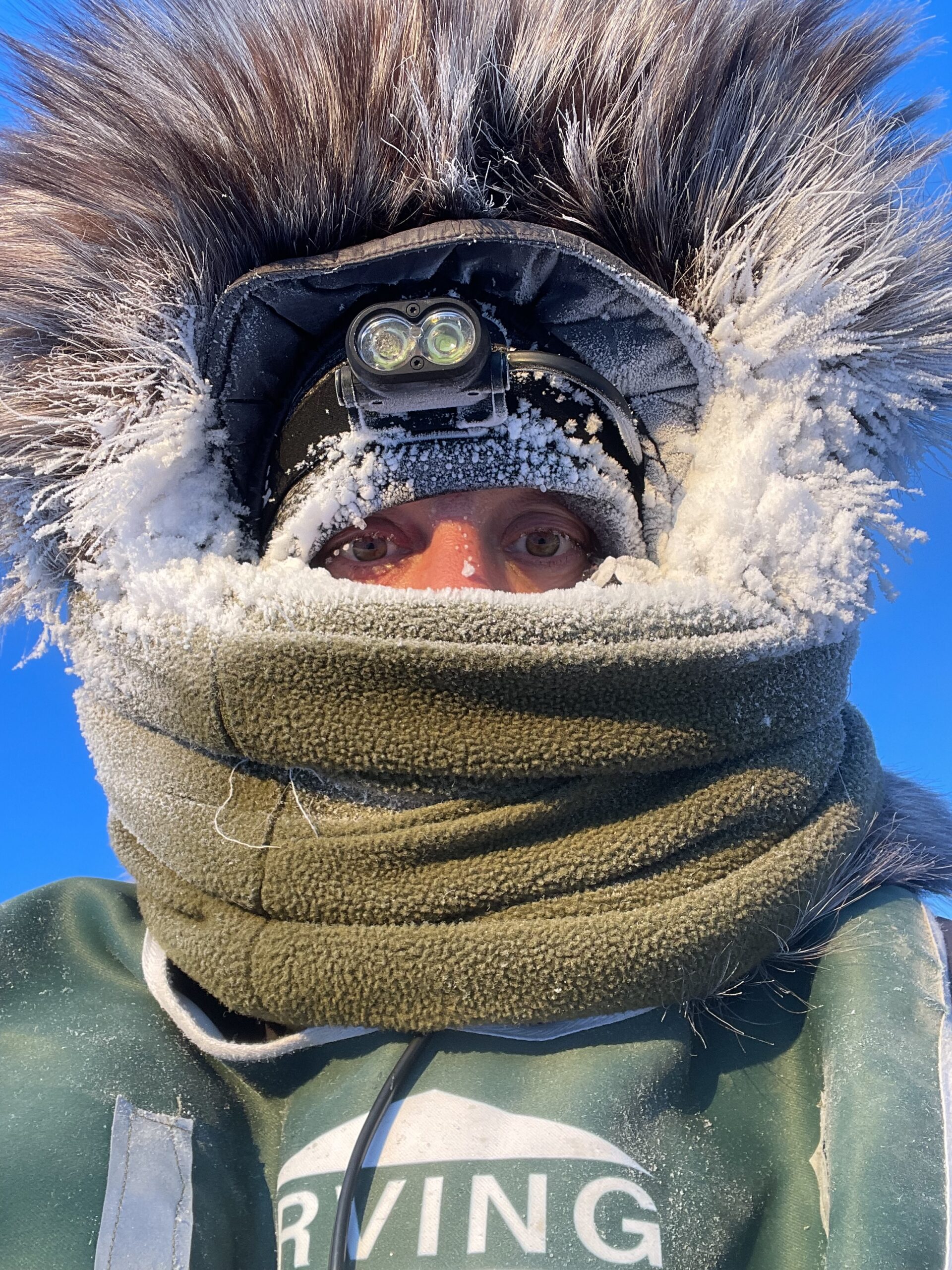
As the sun set, I became legitimately cold. The closer we were to Allagash, the colder I was. I started pumping my arms around, even hoping for some steep hills that I could run up. The chill had taken hold of me, and nothing I did seemed to help. Finally we pulled into Allagash, a wonderful checkpoint next to a small café where I ate French toast and then settled into a bed for a blissful two-hour nap.
Leg Five: Allagash to the Finish, 53 miles, Real Cold
I left the last checkpoint at 2:30 in the morning, solidly in second place. I have learned from many a mishap, however, that sometimes things can fall apart even at the very end. As the leg stretched on, the hills became relentless—so many, so long, so steep—that the dogs were clearly getting burnt out. I personally became very cold again, chilled to my core. I ate my snacks, drank hot coffee, and pumped my arms, and I was still cold.
Finally the sun came over the mountains, at which point I started to warm a bit, but the dogs were struggling even more. They were eating snow constantly, which can be a sign of mental fatigue as much as anything. I decided maybe someone other than Temper should lead so we could maintain momentum. I tried Ruth, Lorna, and Chip, who had all led in the past for me, but they weren’t interested. I tried Riot, even though he had never led. He didn’t want to either. I put Temper back up front with Oreo, and then Temper fully sat down and turned around. I decided to continue with Oreo in solo lead.
It turned out to be a seven-hour-long run to get to the finish. By the time I arrived, I could barely hold myself upright. I had pushed my sled up so many hills that my legs and back were destroyed. But we got there. Second place felt like a marathon more than a race. At the finish, I curled up in the truck cab and took a four-hour nap.
Now home, we’ve moved on to thinking about next year again. I’m harness breaking some of the best puppies I’ve ever seen. The adults will be going to summer camp on a glacier near Juneau again, and I’m preparing for the road trip north.