


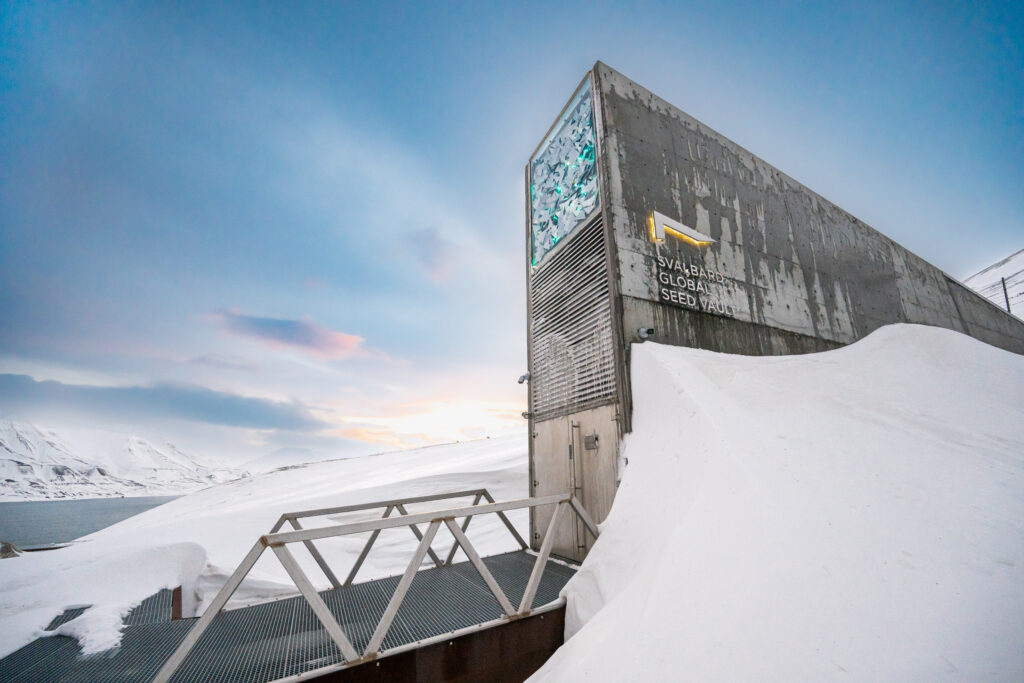
It’s that time of year when Northern Wilds gardeners are buying seeds, planting them, or placing already sprouted plants in their gardens. Speaking of seeds, did you know that on a remote frozen island 800 miles (1,287.4 kilometers) from the North Pole, the world’s largest collection of seeds is stored as a backup against the loss of seeds due to global catastrophes like natural disasters and wars?
The facility is the Svalbard Global Seed Vault, sometimes referred to as the Doomsday Vault or Modern Noah’s Ark. It opened on February 28, 2008, and in early April 2026, there were 69.2 million seeds deposited in the Vault, contained in 1,385,898 seed samples (each sample holds about 500 seeds). The Vault has the capacity to store 2.25 billion seeds covering about 4.5 million varieties of crops. Both Minnesota and Ontario seeds are represented.
The Seed Vault is located 430 feet (130 meters) above sea level on the Norwegian island of Spitsbergen, part of the Svalbard Archipelago in the Arctic Ocean. The Vault is owned by the Kingdom of Norway and managed by Norway’s Ministry of Agriculture and Food, Norway Genetic Resource Center (NordGen), and The Crop Trust, an international organization dedicated to safeguarding the world’s crop diversity for future food security.
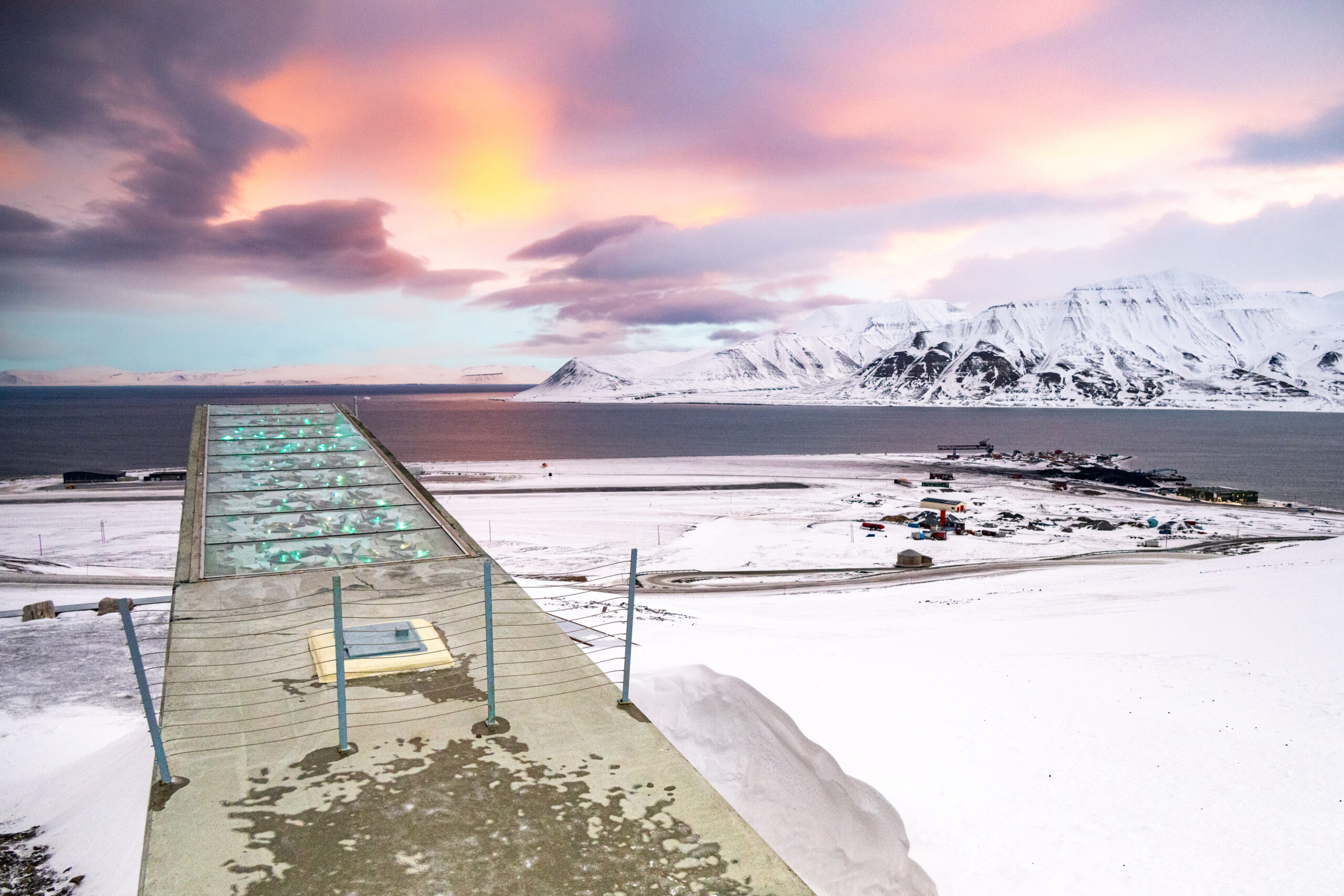
The Vault’s tunnels extend approximately 330 to 426 feet (100 to 130 meters) deep inside a sandstone mountain and lead to three ice-covered rock caverns where the seeds are stored. Designed by architect Peter W. Soderman, it was built by the Norwegian government at a cost of $8.8 million in 2008. The structure is about 3 miles (5 km) from Svalbard’s capital city, Longyearbyen, which has a population of 2,700 from 50 countries and is the farthest north a person can fly on daily scheduled flights.
So, what’s the purpose of the Seed Vault? Well, around the world, there are about 1,700 international, regional, and national seed banks that store seeds for food security. They send duplicates to the Svalbard Global Seed Vault as a safeguard in case their seeds are destroyed. Kind of like an insurance policy against loss. In the article “Saving Seeds for the Future” in Ontario Grain Farm Magazine (August 2025), writer Mary Feldskov quotes Dr. Cary Fowler, an agriculturist who is considered the “father” of the Svalbard Global Seed Vault. “It operates like a safety deposit box at the bank. Depositors send a duplicate copy of their seeds. The Seed Vault protects those seeds free of charge. And if anything happens to the original copy … they can be returned to the depositor. Nobody else has access to them.”
The seeds are stored in three-ply airtight aluminum packages and placed in containers on multi-shelved racks. Storage rooms are kept at a constant temperature of -18°C (-0.4°F). Even if electricity fails, the permafrost surrounding the Vault keeps the seeds frozen. Seeds in these conditions can be kept for hundreds, some even thousands, of years. Interesting side note about seeds: the oldest seeds ever to be brought back to life (2012) were 32,000-year-old Silene stenophylla (narrow-leafed campion) seeds buried 124 feet in the Siberian permafrost.
Indigenous communities have also deposited seeds. In 2015, the first Indigenous deposit was made by the Quechua farmers from the Peruvian Andes, who travelled 6,835 miles (11,000 km) to bring 750 seed samples of sacred potato varieties. Then in 2020, the Cherokee Nation made history when they were the first Native American tribe to deposit their rare traditional heirloom seeds that predate European settlement in North America, including their most sacred Cherokee White Eagle Corn. And in 2024, a group of Indigenous Taiwanese leaders, including members of the Paiwan and Bunun communities, deposited 170 varieties of traditional millet seeds.
While the Seed Vault’s main mission is to protect and conserve plant seeds for food security in the event of a doomsday event, there’s also an artistic and cultural element to the facility. The primary art feature is the illuminated entrance portal by Norwegian artist Dyveke Sanne. The award-winning art installation on the entrance roof and upper facade is named “Perpetual Repercussion” and is a striking, iconic landmark visible from a distance. The work features a blend of triangular, highly reflective pieces of acid-free stainless steel, mirrors, and prisms that reflect polar light during summer. In winter, 200 fibre-optic cables create a beautiful tapestry of muted greenish-turquoise and white light.
The Vault project was the inspiration for the children’s opera Children of Ginko, set in the future and aimed at raising ecological awareness. Other children’s books about the Vault include the fairy tale adventure The Garden at the End of the World and Just in Case: Saving Seeds in the Svalbard Global Seed Vault. Documentaries include Seeds of Time (2013), Seed Battles (2013), and Seed: The Untold Story (2016).
Because of strict security, visitors cannot go inside the Seed Vault; however, they can take a taxi or organized tour to see the exterior, or take a virtual tour online at: seedvaultvirtualtour.com.