


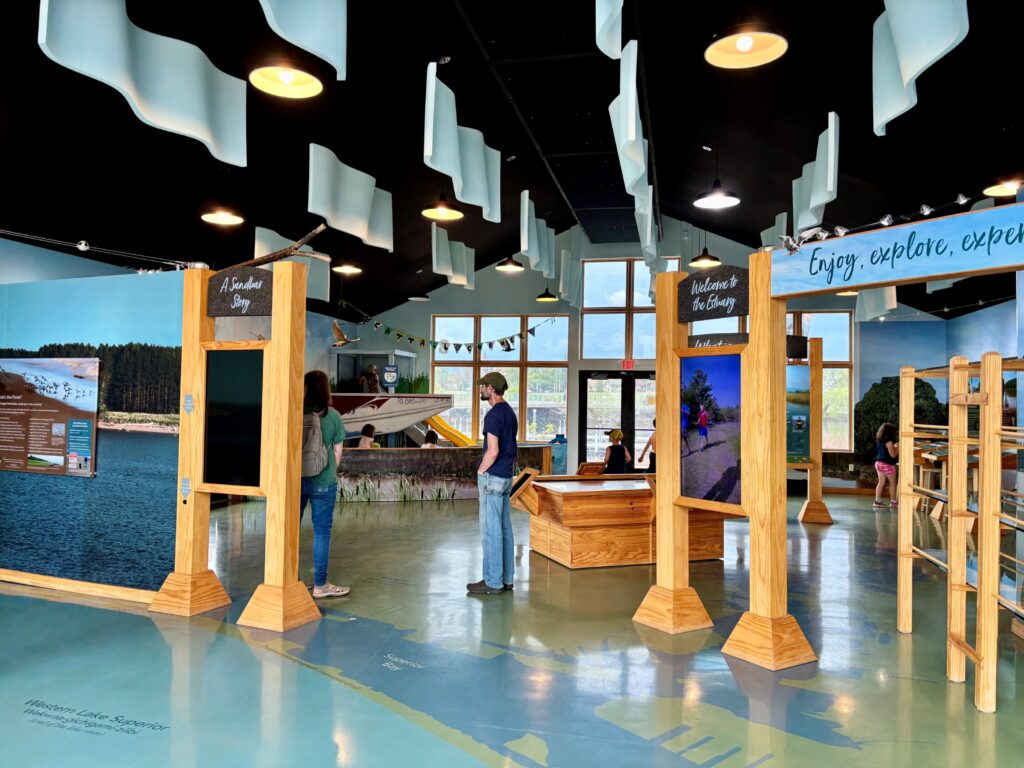
Opened in 2017, the Lake Superior Estuarium, located in Superior on Barker’s Island, is a small but mighty natural history museum. The Estuarium aims to educate the public about the importance of a 16-mile-long waterway that forms the St. Louis River Estuary. In the 1970s, the St. Louis River was one of the most polluted rivers in the United States. However, thanks to the continuing efforts of the U.S. Environmental Protection Agency and other organizations, the river has made a comeback, and the estuary once again provides a habitat rich in plant, animal, and aquatic life.
Entering the Estuarium is an immersive experience. Visitors step onto a wall-to-wall floor of pale green and blue depicting a map of the St. Louis River (Gichigami-ziibi) flowing through Spirit Lake (Manidoo-zaaga’igan), Pokegama Bay (Bakegamaa-wiikwedong), and Superior Bay before emptying into Lake Superior (Gichigami). As visitors walk around, four walls of floor-to-ceiling panoramic murals showcasing the shores of the Lake Superior estuary greet them. Expansive windows look out at the water surrounding Barker’s Island. Overhead, sculptures of aqua-blue waves suspended from the ceiling create a sense of moving water. It’s easy to imagine one is part of the estuary.
Heather McDowell has been a volunteer at the Estuarium for more than two years. She loves her position. “When I look outside and see the water sparkle,” she says, “it’s like I’m on vacation. I meet people from all over.”
After two years of volunteering in the Estuarium, McDowell says she has come to appreciate the importance of the St. Louis Estuary. Last year about 3,500 people visited the museum.
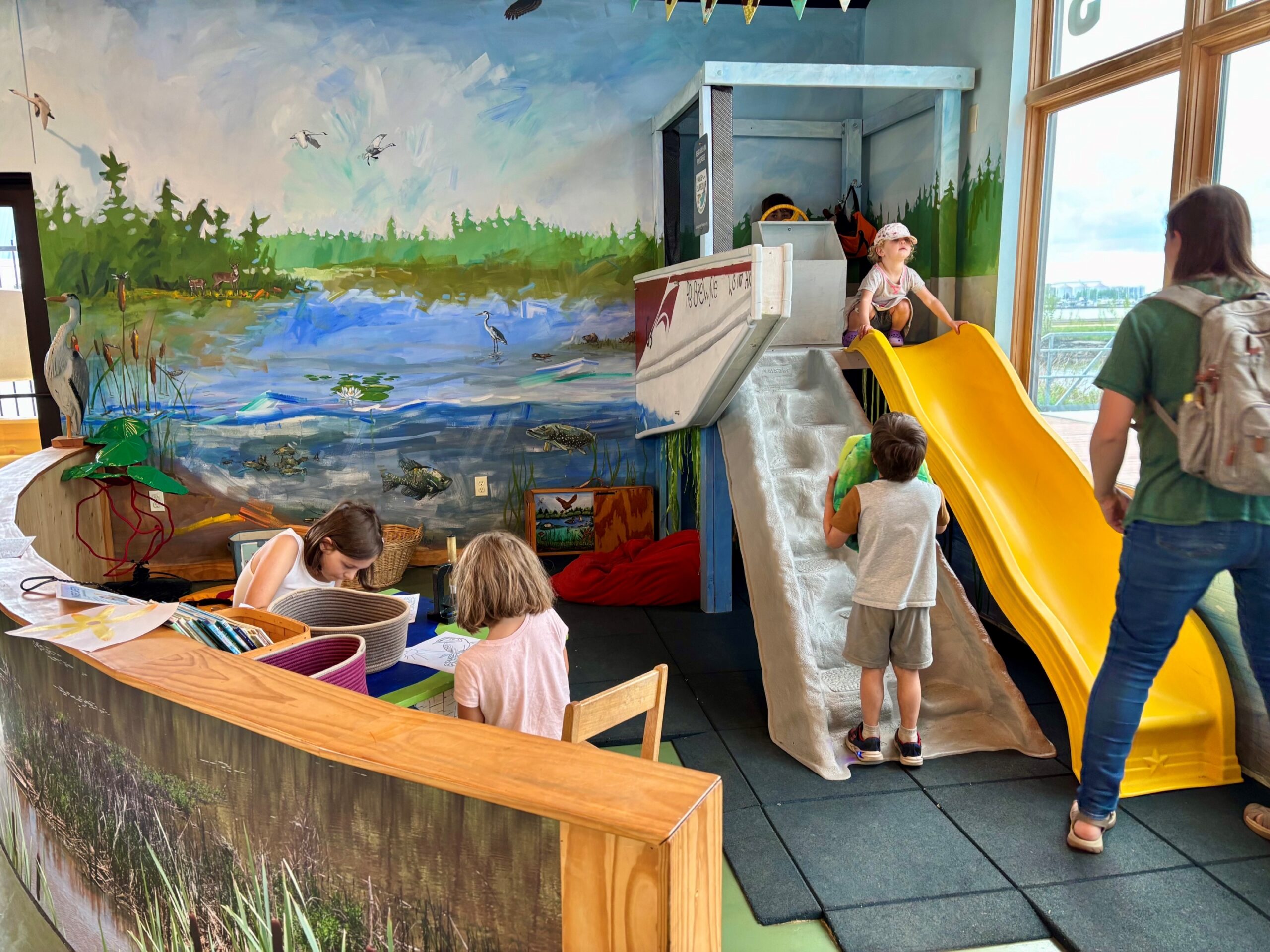
The Estuarium has something for people of all ages, and its small size makes it ideal for families with children because young ones are always within earshot and eyesight. While adults peruse exhibits about the estuary’s history, importance, and ongoing restoration, young children can enjoy the play area. Surrounded by a whimsical hand-painted mural of birds, deer, trees, fish, and lily pads, the children’s area features a slide with a platform camouflaged as a boat. Stocked with nature-themed books, puppets, coloring sheets, crayons, and “water” superhero capes, it’s a place for imagination and fun.
Older children can engage with interactive displays. “Zoom in on the Estuary!” uses a document camera to magnify pieces of plant life encased in plastic onto a computer screen. The “Get in Touch!” display invites children to stick their hands into a slot, feel objects, and guess what they’re touching. “Which of these St. Louis River residents can you spot on your next adventure?” is a laminated booklet featuring photographs of local animals, insects, and fish.
In the center of the Estuarium stands a large table featuring a map of the cities of Superior and Duluth alongside Lake Superior. Four touchscreens mounted to the table each cover a different topic. Listeners learn about the 2012 flood in the Twin Ports and other impactful storms, how the estuary has changed over time, and how dredging impacts the waterway.
Large colorful display panels feature stories about the estuary from the past and present. Among the stories, visitors can read about the removal of the families who once lived on Wisconsin Point after an ownership dispute with the Interstate Railroad Company. They can view a portrait of Chief Osaugie (1802-1876), who helped keep the federal government from removing the Anishinaabe from northern Wisconsin. They can read about the program to restore the piping plover, a small endangered shorebird, to the shores of Lake Superior. Another restoration program involves wild rice (manoomin), an important food source in Anishinaabe culture. Other displays feature stories about the scientific research used to monitor and study the health of the estuary system.
Some exhibits change over time. Last year the Estuarium presented information about plastics in Lake Superior, educating people about how to keep plastic waste out of waterways. This year that space features information about red pines and the history of the intentional burns (ishkode) the Ojibwe once conducted on Wisconsin Point. In 2025, prescribed burns were reintroduced to Wisconsin Point in hopes of creating a more diverse, healthier habitat, allowing native plants like blueberries and red pines to grow and thrive.
The Estuarium is a contemplative space where people learn about and connect with the unique nature of the St. Louis River Estuary. But for those interested in a deeper connection, the reach of the Estuarium extends beyond its walls. It falls under the education umbrella of the Lake Superior National Estuarine Research Reserve, which also sponsors River Rovers and Rivers2Lake, two other educational programs.
River Rovers is a free nature program held in the summer for children ages 3 to 7. The two-hour adventure includes exploring nature, games, a snack, and craft time. Each week focuses on a different nature theme. Children may attend one or more sessions, but they must be accompanied by an adult. The program, held from 10 a.m. to noon, started on Wednesday, June 24, and runs through Aug. 19, skipping Aug. 5. For more information, call 715-399-4093.
Rivers2Lake is an educational program for teachers who wish to learn how to incorporate lessons about Lake Superior and the St. Louis River in their classrooms. After completing the program, Four Corners Elementary teachers Robin Gobler and Melissa Ketola said, “We gained a wealth of knowledge.” They use that knowledge to teach their students “the difference between rivers and lakes, how important water is to an ecosystem, and how to protect it.” They highly recommend the Rivers2Lake program. This year’s application process is closed, but educators interested in participating in the 2027-28 cohort can visit lakesuperiornerr.org or call 715-399-4085.
This summer the Estuarium will be open Tuesday through Saturday from 10 a.m. to 5 p.m. Admission and parking are free. To learn more, visit lakesuperiornerr.org. In addition to the Estuarium, Barker’s Island features the SS Meteor Whaleback Museum, Capt’n J’s Mini Golf, North Shore Stand Up Paddleboarding, a children’s park, and a walking trail.