


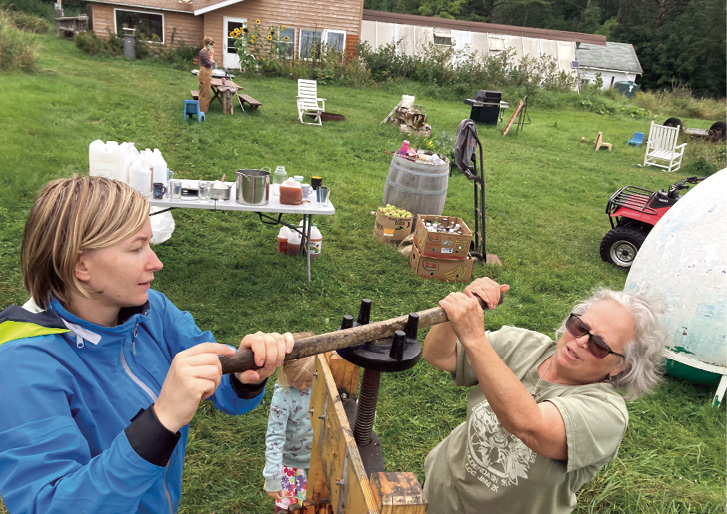
Cindy Hale and Jeff Hall, owners of Clover Valley Farms, first started planting apple trees on their property 25 years ago. Together with their daughter May, they’ve tended the land and watched their various orchards grow and flourish over the years. This fall their apple trees are at peak production.
Likewise, Hale and Hall are at the peak of their own wisdom and reflection on farming’s meaning to them; they’re currently starting the transition to winding down their lengthy agricultural careers. Together we sat down in their backyard tiki bar this harvest season to talk about how they got off the “hamster wheel” five years ago and have gradually pivoted to the arts, as well as how their ecological farming practices have created their high quality of life.
You’ve likely already met Hale and Hall if you appreciate locally-grown foods: the two tabled for years at the Duluth Farmers Market, Two Harbors Farmers Market, Lincoln Park Farmers Market, Duluth Harvest Fest, and countless other community events, selling their trademark homemade vinegars and value-added products, like herb-infused salts. In their heyday, they had 40 wholesale clients for their vinegars, including the Co-Ops in Duluth and Grand Marais. There was enough revenue for Hale and Hall to hire one part-time support staff, but that did little to alleviate their own workload. Going to all the markets, and maintaining all the relationships with wholesale vendors, was still an uphill battle.
“Cindy and I would sit on the sofa every single morning and talk about our colossal task list. And then COVID came, and shut everything down. All our wholesale accounts dried up overnight,” Hall recalls. “At first blush, it was devastating.” Just as Clover Valley Farms had firmly established their products on consumer shelves throughout the Northland—the result of 20 years of slow but steady development of their family business—COVID took it all away.

That’s when Hale and Hall had a revelation: “We found out we could get off our little hamster wheel,” explains Hale. “We realized, ‘Oh, we don’t have to do this. We can if we want to, but we don’t have to.’” The fab farmers gradually started scaling down on time-consuming markets and shows, and likewise cut off their website sales, to the point where they now sell their vinegars only at their home farm stand in the Clover Valley Farm Trail—a Sunday-afternoon “come to the producer” shopping opportunity for buyers who want fresh and local. “I convinced Jeff to stop doing farmers markets, and he’s happy,” Hale smiles. They do make one exception—tabling at Clover Valley Farm Fest each August.
Hale also started working off-farm three years ago, and now works for the Minnesota Department of Agriculture as a grant specialist in their local food purchasing assistance program.
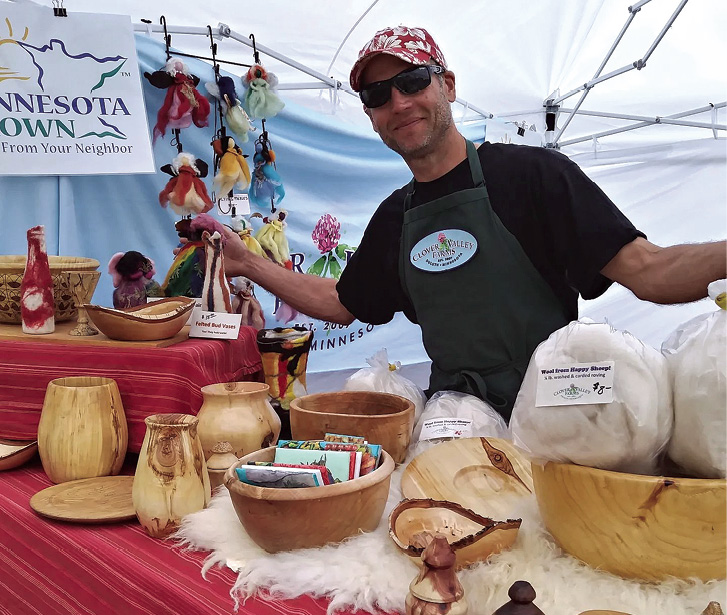
But even in the tough times, Hale and Hall never stopped generating; they just pivoted. Both have increasingly followed their artistic inclinations, while continuing to raise Shetland sheep and rabbits on their beautiful farm nestled on Homestead Road, halfway between Duluth and Two Harbors. For Hall, this pivot to the arts has meant woodturning. Hale sums it up: “Jeff’s essence is an artist and a farmer. There’s always been some artistic endeavor he’s pursued. But when he hit wood, he knew ‘this is what sings.’”
Woodturning is one piece of what Hale and Hall call their “trifecta:” wood, food, and fiber. Hale’s piece is fiber arts. She originally got into making art out of wool accidentally: “We bought sheep because we wanted to use grazing under the orchards rather than mowing. We chose Shetlands because they’re small compared to other breeds, and we thought they’d work well under the trees. Only then did we realize they have this remarkable wool. I got bit by the fiber bug, particularly by natural dying, using buckthorn, goldenrod, tansy, and all this stuff that we have to control.” Hale joined the Duluth Fiber Guild, and now produces her own dyed wool products.
Pursuing wool dying and woodturning as creative outlets has given Hale and Hall a way to replace some of their lost farm income due to COVID, while also giving themselves spiritual satisfaction. Their art is profitable, but more importantly it sustains their high-quality lifestyle.
The last piece of their “trifecta” is food. For Hale and Hall, eating their own farm-raised food is a major input to quality of life. “One of the things that I really value is having my own freezer full of food that I grew,” says Hall. “Between our sheep and rabbit meat, we rarely have to get outside food.” The couple also presses copious amounts of cider each fall from their thousands of pounds of apples (available now at their Clover Valley Farm Trail stand). They make countless other homemade delicacies too, like the elderberry wine that I got to taste (but isn’t for sale). This emphasis on homegrown nutrition is a key to their quality of life, even as they scale back their commercial farming.
A final piece of Hale and Hall’s focus on quality over quantity are the couple’s ecological farming practices. Their tiki bar, for instance is a refuge to happy hummingbirds that feed on the flowers of the trellised scarlet runner beans that adorn the patio.
For Hale, “An ecological focus to farming is really key to our love of nature. We spend as much time making sure we have good bird habitat as we do good production. That’s important.” Hall concurs: “When I move the sheep, if there’s a bird nest or some kind of cool plant, I won’t put the sheep in that spot. I can move the fence however I want. The sheep could devastate a bird’s nest. The birds provide pest management in our fields and orchards. We have bluebird nests, and swallow nests, and they eat insects all day long.” Indeed, when they planted the original orchard 25 years ago, Hale and Hall fenced it with spruce poles, harvested from the property, as fence posts. A bluebird couple has been using one of the old spruce posts as their nesting hole for years.
Today, Hale and Hall are consciously thinking about retirement. They’re taking gradual steps to downsize to homestead—rather than farm—size. Their legacy of adapting their farm again and again, while emphasizing quality of life over quantity of accounts, and simultaneously pursuing artistic creativity that ties in with their farm work, has given them a sweet spot in the clover.